


Blog
Cannabis Trichomes Explained: Types, Appearance and Why They Matter

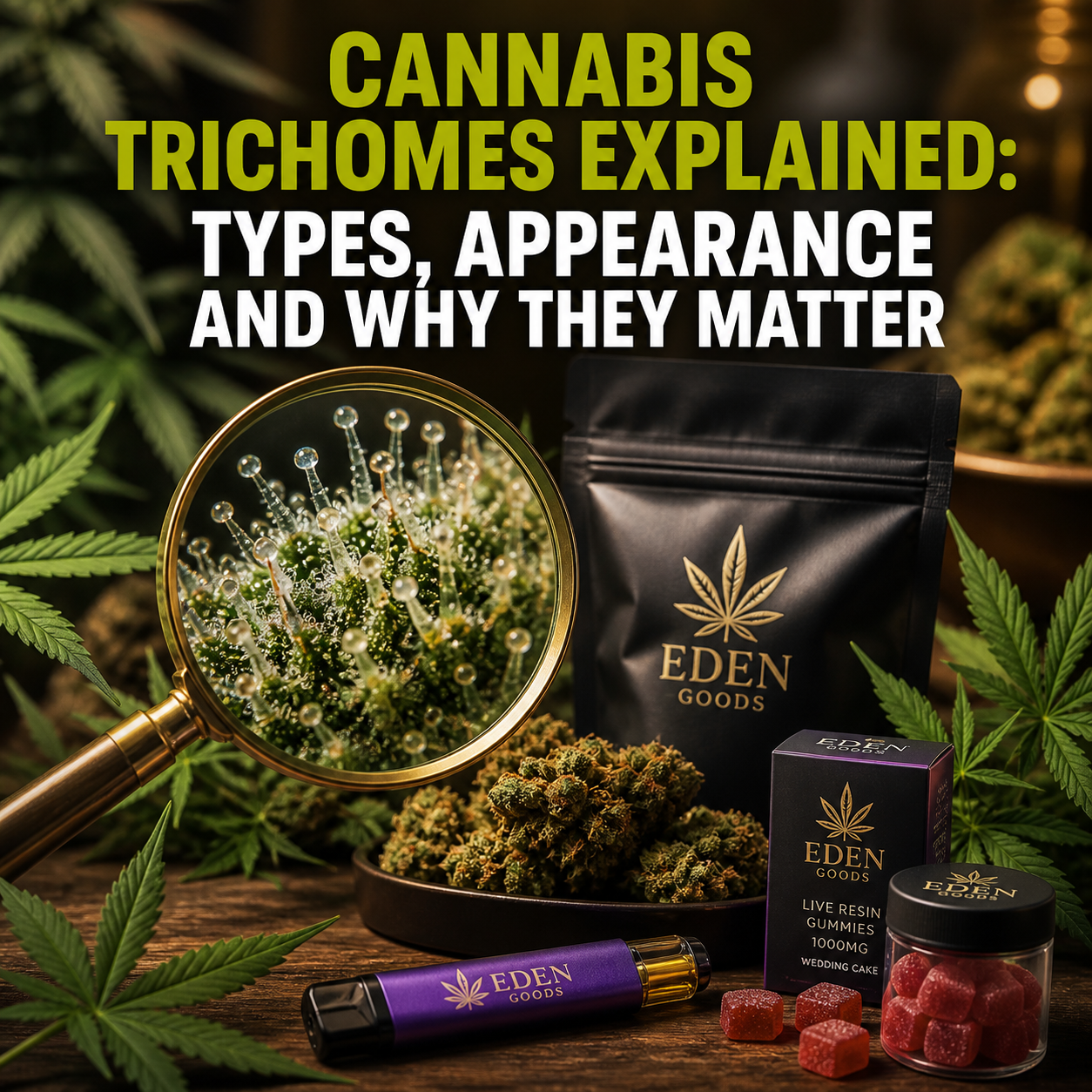
Cannabis Trichomes Explained: Types, Appearance and Why They Matter
Cannabis trichomes are the tiny structures that give many cannabis flowers their frosted, sparkling appearance. Although they may look like simple crystals, they have a much more important role. Glandular trichomes produce and store much of the resin associated with cannabinoids, aromatic compounds and other plant chemicals.
Learning to recognize trichomes can help you understand how a cannabis flower developed, why it smells the way it does and how careful handling affects its quality. Their appearance may also provide clues about maturity. However, trichome color cannot confirm potency, safety or a product’s cannabinoid profile on its own.
This cannabis trichomes guide explains the main types, their appearance and their biological purpose. It also covers common misconceptions, storage practices and the difference between healthy resin glands, mold and other material found on cannabis flower.
What Are Cannabis Trichomes?
The word trichome comes from a Greek term meaning hair. In botany, it describes small outgrowths that form on the surface of a plant. Trichomes occur across the plant kingdom and can have different shapes, sizes and functions.
Cannabis produces both glandular and non-glandular trichomes. Glandular trichomes are especially significant because they develop resinous heads. These heads are major sites for the production and accumulation of cannabinoids and terpenes. Non-glandular structures do not produce the same resin-rich heads and often serve more physical protective roles.
To the naked eye, a dense layer of glandular trichomes often looks like sugar, frost or very fine glass beads. Under magnification, individual trichomes may resemble tiny mushrooms, with a rounded head supported by a short or elongated stalk.
Why Cannabis Plants Produce Trichomes
Trichomes exist for the plant, not for the consumer. They form part of the cannabis plant’s natural defense and reproductive strategy. Their sticky secretions and strong aromatic compounds may discourage some insects and grazing animals. The surface layer can also help protect delicate floral tissues from environmental stress.
Researchers continue to examine the precise functions of individual compounds and structures. In general, the roles associated with cannabis trichomes include:
- Producing and storing resinous plant compounds.
- Helping deter certain pests and herbivores.
- Creating a sticky physical barrier on flowers and nearby leaves.
- Contributing to protection from intense environmental exposure.
- Supporting the plant’s distinctive aroma through volatile compounds.
Trichomes occur most densely on unfertilized female flowers, particularly around the bracts that surround reproductive structures. They can also appear on sugar leaves and, in smaller quantities or different forms, on other above-ground parts of the plant.
The Main Types of Cannabis Trichomes
Several trichome classifications appear in botanical literature. For practical identification, three glandular types are most often discussed: bulbous, capitate-sessile and capitate-stalked trichomes. Their proportions and dimensions vary by cultivar, plant tissue and stage of development.
| Trichome type | Typical appearance | Where it is commonly found | Key characteristic |
| Bulbous | Extremely small and rounded | Across various aerial plant surfaces | Difficult to see without strong magnification |
| Capitate-sessile | Rounded glandular head with a very short stalk | Leaves and developing floral tissue | More visible than bulbous trichomes but still small |
| Capitate-stalked | Large round head on a distinct stalk | Abundant on mature flowers and surrounding sugar leaves | Produces the most noticeable resinous coating |
Bulbous trichomes
Bulbous trichomes are the smallest of the commonly recognized types. They consist of only a few cells and are generally too small to assess with the naked eye. They can occur on stems, leaves and flowers. Because of their minute size, they contribute less to the visibly frosted appearance of mature cannabis than larger glandular structures.
Capitate-sessile trichomes
Capitate-sessile trichomes have a rounded secretory head positioned on a short stalk. The stalk can be difficult to distinguish without suitable magnification, making the head appear almost flush with the plant surface. These trichomes develop on leaves and floral tissue and become more prominent as the plant matures.
Capitate-stalked trichomes
Capitate-stalked trichomes are the largest and most recognizable resin glands on cannabis flower. They have a distinct multicellular stalk topped by a bulbous glandular head. Secretory cells within the head produce compounds that accumulate beneath its outer layer.
These are the structures most people notice when examining resin-rich flower. They are also fragile. Friction, compression, excessive warmth and repeated handling can detach the heads or damage the stalks.
What Do Cannabis Trichomes Look Like?
Without magnification, healthy trichomes usually look like a fine crystalline coating. They reflect light, creating a glistening or frosted effect. High concentrations may make the flower and its small surrounding leaves appear dusted with sugar.
Under a loupe or microscope, the larger trichomes have clearer boundaries. Their heads appear spherical or oval, while their stalks rise from the plant tissue. Depending on maturity, genetics, light and viewing conditions, the heads may look clear, cloudy, milky or amber.
Appearance differs between cultivars. One flower may develop long, obvious stalks, while another carries smaller or denser glands. Color can also look different under warm indoor lighting. Neutral white light and a stable magnified view provide a more reliable visual impression.
Where to look for them
The greatest visible concentration usually occurs on floral bracts and nearby sugar leaves. Large fan leaves tend to carry fewer prominent glandular trichomes. When assessing flower, it is therefore important to examine the flower itself rather than relying only on a protruding leaf.
Explore different flower structures and presentations through [[LIEN_INTERNE: cannabis flower]].
Understanding Clear, Cloudy and Amber Trichomes
Trichome color changes as glandular heads develop and age. Growers often observe these changes when evaluating plant maturity. Consumers may also notice color differences in finished flower. However, visual assessment is subjective and cannot replace laboratory analysis.
| Appearance | General interpretation | Important limitation |
| Clear or transparent | Often associated with less mature glandular heads | Reflections can make cloudy heads appear clear |
| Cloudy or milky | Common in mature, resin-rich flowers | Does not reveal exact THC, CBD or terpene levels |
| Amber or golden | Can appear as trichomes age and compounds change | May also be influenced by cultivar, oxidation, storage or lighting |
| Dark brown or collapsed | May indicate advanced aging, damage or degradation | A full assessment requires more than color alone |
Clear trichomes
Young glandular heads often appear transparent. Their internal composition is still developing. Yet photographs and direct observation can be misleading. Focus, glare and the angle of illumination affect whether a trichome looks clear.
Cloudy or milky trichomes
As trichomes mature, many become opaque or milky. Changes within the glandular head alter how it reflects and transmits light. Cloudiness is commonly associated with mature resin production, but it does not prove that a flower has high potency or a specific chemical profile.
Amber trichomes
Some heads turn yellow, gold or amber as they age. This color may accompany oxidation and other chemical changes. A small proportion of amber glands can occur naturally on mature flower. Widespread darkening, especially alongside a stale odor or brittle texture, may instead suggest prolonged storage or deterioration.
There is no universal color ratio that suits every cultivar or intended product. Genetics, environment and sampling location all affect the result. Local laws must always be followed, and cultivation decisions should rely on legal, informed guidance.
Why Cannabis Trichomes Matter
They are closely linked to cannabinoids
Glandular trichomes are major production and storage sites for phytocannabinoids. These compounds begin in acidic forms within the living plant and may change through heat, time or environmental exposure. THC and CBD are among the best-known cannabinoids, but cannabis produces many others in varying amounts.
You cannot identify cannabinoids by looking at trichomes. A frosty flower is not automatically high in THC, and sparse-looking flower is not automatically weak. Only reliable testing can quantify cannabinoid content.
They contribute to aroma
Trichomes also produce terpenes and other volatile compounds that influence the flower’s aroma. Depending on the cultivar, these may create citrus, earthy, pine-like, floral, spicy or fuel-like notes. The overall scent results from a complex mixture rather than a single terpene.
Strong aroma does not guarantee freshness or quality. Added fragrances, poor storage and microbial contamination can complicate sensory assessment. Product labeling, testing information and a trustworthy supplier remain important.
They influence texture and handling
Fresh resinous flower may feel slightly sticky because of its glandular surface. Excessive dryness can make trichomes brittle and easier to dislodge. Too much moisture, on the other hand, raises storage concerns and may encourage microbial growth.
Trichome heads that separate from dried flower contribute to the fine powder commonly called kief. Loose material at the bottom of a container is not always a sign of poor quality, but excessive agitation can increase trichome loss.
Trichomes vs Mold: How to Tell the Difference
Trichomes are sometimes confused with powdery mildew, mold or foreign particles. This distinction matters because contaminated cannabis should not be used. Visual inspection can identify warning signs, but it cannot detect every contaminant.
| Feature | Trichomes | Possible mold or mildew |
| Shape under magnification | Defined heads, often on stalks | Thread-like, web-like or irregular fuzzy growth |
| Distribution | Organized across flower surfaces | Patchy areas that may penetrate the flower |
| Texture | Resinous or crystalline | Cottony, dusty or unusually soft |
| Odor | Characteristic plant aroma | Musty, damp, basement-like or otherwise abnormal |
Mold can be white, gray, brown or black. It may hide inside dense flowers rather than appearing only on the surface. Do not rely on smell alone, and do not attempt to remove one affected area while using the rest. If contamination is suspected, avoid the product and contact the retailer or producer.
People with asthma, allergies, weakened immunity or other health concerns may face greater risks from contaminated material. If exposure causes breathing difficulty or another concerning symptom, seek prompt medical advice.
Do More Trichomes Mean Better Cannabis?
A heavy trichome coating can reflect favorable genetics and careful flower development, but quantity alone does not define quality. Resin density cannot confirm safety, potency, freshness or a desirable experience.
A broader evaluation should consider:
- Accurate, compliant product labeling.
- Testing information where regulated testing is available.
- A normal appearance without pests or microbial growth.
- An aroma consistent with the product and free from musty notes.
- Appropriate moisture, without dampness or extreme brittleness.
- Responsible cultivation, processing, packaging and storage.
- A reputable seller that provides clear product information.
Effects also vary from person to person. Cannabinoid profile, dose, method of use, tolerance, medications and personal health can all matter. Visual appearance should never guide medical treatment. If you are considering cannabis for a health condition, discuss it with a qualified healthcare professional.
How Handling and Storage Affect Cannabis Trichomes
Trichomes are delicate after harvest. Their stalks can break, and glandular heads can detach from the flower. Heat, oxygen, light, friction and unsuitable humidity may also affect aromatic and resinous compounds over time.
To help preserve legally purchased cannabis flower:
- Keep it in a clean, well-sealed container intended for storage.
- Store it in a cool, dark and dry place away from direct sunlight.
- Avoid frequent shaking, crushing or unnecessary handling.
- Do not expose it to high temperatures or rapid temperature changes.
- Keep it away from children, teenagers and pets.
- Follow the manufacturer’s label and local storage requirements.
A refrigerator or freezer is not automatically ideal. Temperature changes can create condensation, while freezing can make trichomes more brittle. The original packaging may be preferable when it is resealable, protective and required for compliant storage.
Common Cannabis Trichome Myths
Myth: Every visible crystal is THC
Trichomes contain complex mixtures of cannabinoids, terpenes and other plant substances. They are not crystals of pure THC. Their appearance cannot reveal the concentration of any single compound.
Myth: Amber trichomes always mean stronger effects
Amber coloration often relates to aging and chemical change. It does not reliably predict strength or a specific experience. Laboratory results and responsible dosing provide more useful information than color alone.
Myth: Frostier flower is always safer
Trichome density does not show whether a product is free from pesticides, microbes, heavy metals or other contaminants. Safety depends on production standards, testing and proper storage.
Myth: White material on cannabis is always resin
Healthy glandular heads have recognizable shapes under magnification. Irregular fuzz, webbing, powdery patches or a musty odor can indicate contamination. When uncertain, do not use the flower.
Frequently Asked Questions About Cannabis Trichomes
Can you see cannabis trichomes without magnification?
Yes. Dense trichomes appear as a frosted or sparkling layer. A loupe or microscope is needed to see individual stalks, glandular heads and color changes clearly.
Are trichomes the same as kief?
Not exactly. Trichomes are structures on the plant. Kief is the loose resinous material collected when glandular heads and related particles separate from dried flower.
Can trichomes tell you how much THC a flower contains?
No. Visible resin density and color cannot measure THC. A laboratory test is required to determine cannabinoid concentrations with meaningful accuracy.
Why do cannabis trichomes turn amber?
They may turn amber as they mature and age. Oxidation, light, heat, genetics and storage conditions can influence the change, so color needs context.
Can CBD and THC trichomes look different?
No reliable visual difference identifies CBD-rich or THC-rich flower. Both can produce similar glandular trichomes. Check verified labeling and test results instead.
What damages trichomes?
Excessive handling, crushing, heat, strong light, oxygen exposure and unsuitable storage conditions can damage trichomes or alter the compounds they contain.
Are brown trichomes a sign of mold?
Not necessarily. Trichomes can darken with age, while mold usually has irregular, fuzzy or thread-like growth. Avoid the product if you cannot confidently rule out contamination.
Conclusion: What Cannabis Trichomes Can and Cannot Reveal
Cannabis trichomes are specialized plant structures with essential biological functions. The largest glandular types create the familiar frosted coating of cannabis flower and serve as important production and storage sites for cannabinoids, terpenes and other compounds.
Clear, cloudy and amber heads may offer useful clues about development and aging. Still, appearance alone cannot establish potency, chemical composition, safety or suitability for medical use. Responsible assessment combines visual inspection with accurate labeling, regulated testing, proper storage and information from a reputable source.
Use this cannabis trichomes guide as an educational reference rather than medical advice. Cannabis may cause unwanted effects and interact with medicines. Depending on your health, age and circumstances, it is recommended to speak with your doctor or pharmacist before use.
To continue exploring carefully presented products and practical care solutions, discover the Sphère Santé product range and select options suited to your individual needs.