
Blog
Decarboxylation for Cannabis Edibles: How THC Activation Works

Decarboxylation for Cannabis Edibles: How THC Activation Works
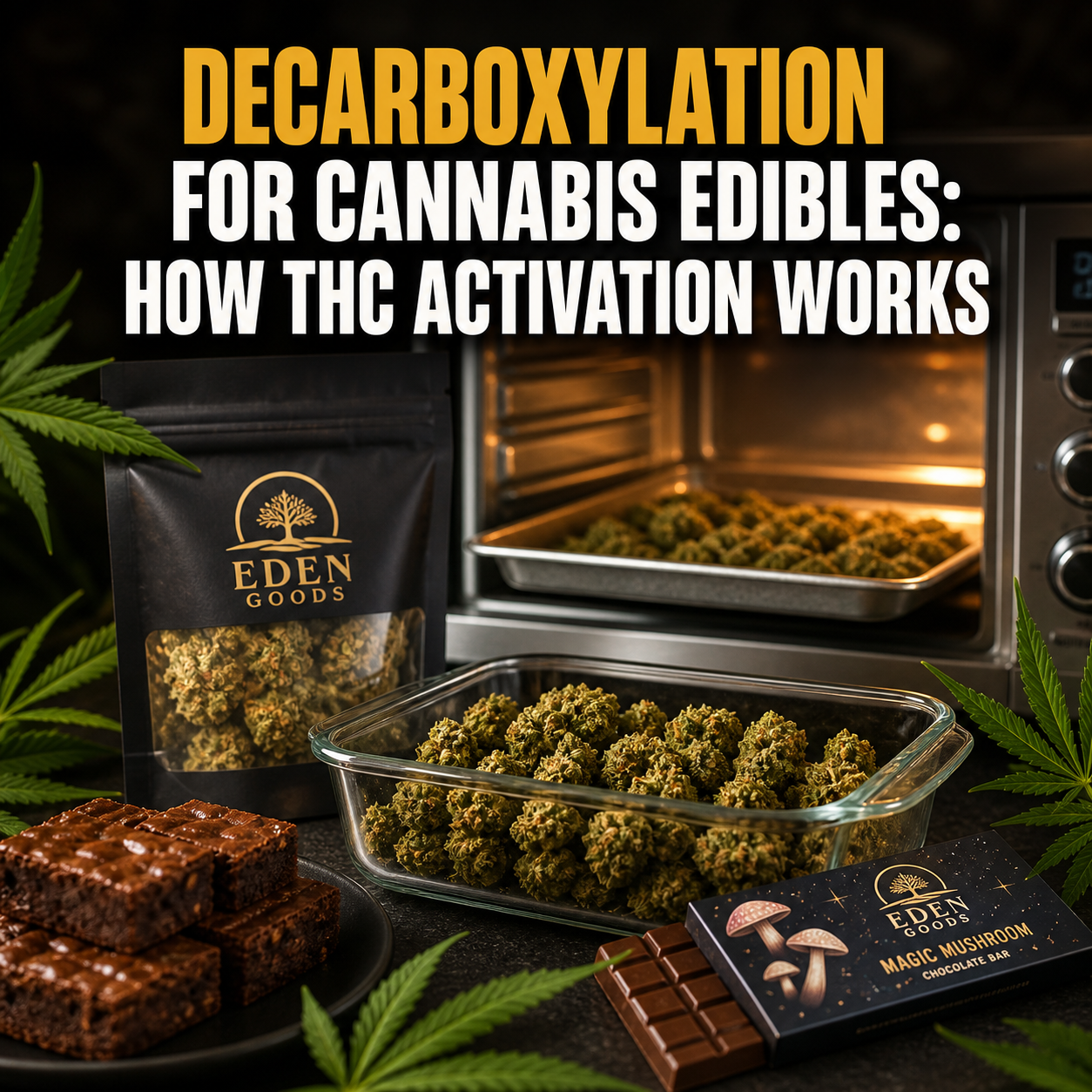
Decarboxylation for cannabis edibles is the process that converts naturally occurring cannabinoid acids into forms that interact differently with the body. In simple terms, controlled heat changes THCA into THC. Without this step, cannabis added directly to food may produce weaker or less predictable intoxicating effects.
The basic idea is straightforward, but achieving consistent results at home is not. Temperature, time, moisture, plant composition, equipment accuracy, and storage can all change the outcome. Excessive heat may also degrade cannabinoids and aromatic compounds.
This guide explains the science, practical variables, common mistakes, and essential safety precautions. It is intended for adults in places where cannabis possession and preparation are legal. It does not replace local regulations, product instructions, laboratory testing, or advice from a qualified healthcare professional.
What Is Decarboxylation?
Raw and freshly harvested cannabis contains many cannabinoids in their acidic forms. These include tetrahydrocannabinolic acid, known as THCA, and cannabidiolic acid, known as CBDA. Heat removes a carboxyl group from these molecules. Carbon dioxide is released, and the molecular structure changes.
During this reaction:
- THCA becomes THC.
- CBDA becomes CBD.
- CBGA can become CBG.
The word “activation” is commonly used to describe this conversion. However, it should not imply that raw cannabinoids have no biological properties. THCA and CBDA are distinct compounds that may interact with the body differently. Research into their effects continues, and they should not be treated as interchangeable with THC or CBD.
Why smoking and vaping do not require a separate step
Smoking and vaping expose cannabis to heat immediately before inhalation. Decarboxylation therefore occurs rapidly during use, although high temperatures can also destroy part of the cannabinoid content.
Edibles work differently. Simply mixing raw flower into a cold recipe does not provide the same immediate heat exposure. Cannabis intended for an edible is generally decarboxylated before infusion unless a tested concentrate or manufactured ingredient is already activated.
Why Decarboxylation for Cannabis Edibles Matters
THC produces the intoxicating effects commonly associated with cannabis. Because raw flower usually contains much more THCA than THC, skipping decarboxylation can leave a substantial portion of the potential THC unavailable in its converted form.
The process also affects consistency. Uneven heating may create material with different cannabinoid concentrations from one portion to another. That variation can carry over into an oil, butter, or finished edible.
Decarboxylation does not make homemade products equivalent to regulated edibles. Laboratory-tested products provide more reliable information about cannabinoid content. Home preparation cannot confirm final potency, even when measurements and heating conditions appear precise.
Decarboxylation is not the same as infusion
These two stages are often confused:
- Decarboxylation uses heat to convert acidic cannabinoids into neutral cannabinoids.
- Infusion transfers cannabinoids into a carrier such as oil or butter.
Cannabinoids dissolve more readily in fats than in water. This explains why many edible preparations use a fatty carrier. However, adding fat does not replace decarboxylation. The conversion and transfer stages serve different purposes.
How Heat and Time Activate THC
Decarboxylation depends on the relationship between temperature and exposure time. Lower temperatures generally require more time. Higher temperatures can accelerate conversion, but they also increase the risk of degradation, scorching, and loss of volatile compounds.
There is no universal setting that works perfectly for every batch. Cannabis varieties differ in moisture, density, age, cannabinoid profile, and processing history. Household ovens can also fluctuate significantly around the selected temperature.
| Variable | Why it matters | Practical consideration |
| Temperature | Controls the speed of cannabinoid conversion | Excessive heat can degrade THC and aromatic compounds |
| Heating time | Allows the reaction to progress | Longer is not always better |
| Moisture | Can slow initial heating and create uneven results | Damp material may need more time to heat uniformly |
| Particle size | Affects heat distribution | Very fine material can heat too quickly or scorch |
| Equipment | Determines temperature stability | An independent oven thermometer may reveal inaccuracies |
| Container and depth | Influence airflow and heat penetration | A thick, crowded layer may heat unevenly |
Common temperature and time ranges
Many home guides refer to a low oven range of approximately 105 to 120 degrees Celsius, or 220 to 250 degrees Fahrenheit, for roughly 30 to 60 minutes. These figures are general reference points rather than a validated formula. Different materials and appliances may require different conditions.
Commercial processors use controlled equipment and laboratory testing to determine conversion and degradation. A home oven cannot provide that level of precision. Avoid assuming that one temperature and time combination guarantees complete activation or a specific potency.
Why higher heat is not necessarily more effective
THC can degrade with prolonged exposure to heat, oxygen, and light. Some of it may gradually convert into other compounds, including CBN. Aromatic terpenes may evaporate at lower temperatures than cannabinoids require for decarboxylation.
A very hot oven may therefore shorten the process while reducing overall quality and predictability. Scorching is a sign of overheating, not successful activation.
A Safety-First Decarboxylation Workflow
Only prepare cannabis where doing so is legal. Check local rules concerning possession limits, home processing, transport, and edible products. If the original product includes preparation instructions, follow those instructions rather than relying on a general online method.
- Confirm the starting material. Check whether the product is raw, partially activated, or already decarboxylated. Distillates and some concentrates may not require further activation.
- Use suitable equipment. Choose a clean, heat-safe tray or container. An independent oven thermometer can help identify temperature differences.
- Break up the material gently. Aim for reasonably even pieces. Grinding it into a fine powder can increase exposure and the risk of scorching.
- Spread it evenly. Avoid a thick or tightly packed layer. Uniform distribution supports more consistent heating.
- Apply controlled low heat. Use validated product guidance when available. Do not rely on color or smell as a precise measure of conversion.
- Allow it to cool safely. Keep it away from children, pets, and anyone who could mistake it for ordinary food.
- Label and store it securely. Include the contents and date. Use child-resistant packaging where available.
Heating cannabis may create a strong odor. Ensure safe ventilation, but never leave an oven unattended. Do not use equipment with exposed flames near oils, paper, alcohol-based extracts, or other flammable materials.
Should cannabis be covered during heating?
Some people use a covered, oven-safe container to reduce odor and limit exposure to moving air. Others use an open tray for more direct heating. Both approaches may change heat distribution and moisture release.
A sealed container can develop pressure if it is not designed for oven use. Never heat an ordinary closed jar or unsuitable container. Follow the cookware manufacturer’s instructions and allow hot containers to cool before opening.
Can a microwave be used?
A microwave is not recommended for controlled decarboxylation. Microwave energy can create hot spots, uneven conversion, and localized burning. It is difficult to monitor the actual temperature of the plant material. Results are therefore especially unpredictable.
How to Know Whether Cannabis Is Decarboxylated
Appearance and aroma can provide clues, but they cannot confirm cannabinoid conversion. Heated cannabis may become drier, slightly darker, and more aromatic. These changes vary by cultivar, age, and starting condition.
Dark brown or black material may have overheated. A burnt smell also suggests excessive temperature. However, a light brown color does not prove that decarboxylation is complete.
Only analytical testing can measure remaining THCA, converted THC, and degradation products accurately. Home cooks should treat potency calculations as estimates, not facts.
Estimating THC Potency After Decarboxylation
A product label or laboratory certificate may list THC and THCA separately. Because THCA loses part of its molecular mass during decarboxylation, it does not convert to an equal weight of THC.
A common theoretical calculation is:
Potential total THC = existing THC + THCA multiplied by 0.877
The factor reflects the difference in molecular mass after carbon dioxide is released. It does not account for incomplete conversion, heat degradation, material left on equipment, inefficient infusion, uneven mixing, or losses during cooking.
For this reason, dividing a theoretical total by the number of servings can create false confidence. Homemade edibles may contain more or less THC than expected. They may also have uneven distribution between portions.
Why laboratory-tested edibles are more predictable
Regulated products generally provide a measured amount of THC per serving and per package. Rules and accuracy standards vary by location, so consumers should still read the complete label.
For people who need consistent dosing, a legal, tested product is usually more predictable than a homemade edible. Explore more educational resources in [[LIEN_INTERNE: cannabis edibles]].
Common Decarboxylation Mistakes
Using excessive heat
Turning up the temperature to save time may burn plant material and accelerate cannabinoid degradation. It can also increase odor and fire risk.
Assuming color proves completion
Visual changes are not a potency test. Cannabis can look properly toasted while retaining THCA or losing part of its THC.
Heating material that is already activated
Some oils, distillates, capsules, and concentrates already contain active THC. Additional heating may be unnecessary and could reduce quality. Check the label or ask the licensed supplier.
Grinding too finely
Powdered cannabis may heat unevenly, scorch, and pass into the final food. A coarse, consistent texture is usually easier to manage.
Relying on oven settings alone
Domestic ovens cycle above and below their selected temperature. An oven thermometer can reveal major differences, although it cannot provide laboratory-level control.
Failing to mix the final edible thoroughly
Evenly decarboxylated cannabis can still produce inconsistent servings if the infused ingredient is not distributed throughout the recipe. Never assume that two homemade portions contain the same amount.
Using Cannabis Edibles More Safely
Oral THC behaves differently from inhaled cannabis. The liver converts part of the THC into 11-hydroxy-THC, a metabolite that may produce strong and long-lasting effects. Edibles also have a delayed onset. Some people feel little at first and then experience unexpectedly intense effects later.
To reduce avoidable harm:
- Choose legal products with clear THC labeling whenever possible.
- Start with a low labeled serving, especially if you have little experience.
- Follow the package waiting-time instructions before considering more.
- Do not mix cannabis with alcohol or other intoxicants.
- Do not drive, cycle, operate machinery, cook over an open flame, or supervise vulnerable people while impaired.
- Use cannabis in a familiar, safe environment with a trusted adult nearby.
- Store every edible in locked, child-resistant packaging.
- Never package cannabis in a way that resembles ordinary sweets or snacks.
Older adults may be more vulnerable to dizziness, falls, confusion, changes in blood pressure, and medication interactions. Anyone taking prescription medicine should discuss cannabis with a doctor or pharmacist. This is especially important for sedatives, anticoagulants, antiseizure medicines, and drugs with a narrow therapeutic range.
When to seek medical advice
Speak with a healthcare professional before using THC if you are pregnant or breastfeeding, have a heart condition, experience severe anxiety, or have a personal or family history of psychosis. Medical advice is also recommended for older adults and people managing several health conditions.
Seek urgent help after cannabis use if someone has chest pain, trouble breathing, a seizure, severe confusion, repeated vomiting, unusual behavior, or cannot be awakened. Contact local emergency services or a poison control service. Do not induce vomiting unless a healthcare professional specifically instructs you to do so.
Storage and Accidental Ingestion Prevention
Decarboxylated cannabis and finished edibles should be treated as controlled household substances. Keep them in a locked location that children, visitors, and pets cannot access. Refrigeration or freezing alone is not enough if the container remains accessible.
Use a clearly labeled, child-resistant container. Store cannabis separately from ordinary food. Include the preparation date and a warning that the product contains THC. Avoid familiar biscuit tins, candy bags, or unmarked food containers.
Pets can become seriously ill after ingesting THC, particularly when edibles also contain chocolate, raisins, xylitol, or other toxic ingredients. Contact a veterinarian promptly if exposure is suspected.
Frequently Asked Questions
Can you make edibles without decarboxylating cannabis?
You can add raw cannabis to food, but it will generally contain more THCA than THC. The intoxicating effect may therefore be weaker or unpredictable unless sufficient heating occurs during cooking.
Does baking an edible decarboxylate the cannabis?
It may convert some THCA, but the food’s internal temperature, moisture, and baking time affect the result. Separate decarboxylation generally offers more control, although home potency remains uncertain.
Can cannabis be decarboxylated for too long?
Yes. Prolonged heating can degrade THC and reduce aromatic compounds. More time does not always create a stronger final product.
Does decarboxylation smell?
Yes. Heating cannabis can release a strong and recognizable odor. Safe ventilation may help, but it does not eliminate the smell completely.
Do all cannabis concentrates need decarboxylation?
No. Distillates and some processed concentrates may already contain active THC. Check the product label or ask the licensed supplier before applying more heat.
Can you calculate the exact strength of homemade edibles?
No. A calculation can provide a theoretical estimate, but only laboratory testing can determine final cannabinoid content and serving uniformity accurately.
How should decarboxylated cannabis be stored?
Keep it in a clearly labeled, airtight, child-resistant container away from heat, light, moisture, children, and pets. Follow all local storage laws.
Conclusion
Decarboxylation for cannabis edibles converts THCA into THC through controlled exposure to heat. Temperature and time both matter, but starting material, moisture, equipment, and handling also influence the result. No visual sign or home calculation can confirm exact potency.
Where cannabis is legal, careful temperature control, secure storage, clear labeling, and conservative consumption may reduce common risks. Laboratory-tested edibles remain more predictable than homemade preparations. If cannabis could affect an existing condition or interact with medication, speak with a doctor or pharmacist before use.
For everyday comfort, discreet continence support, and practical solutions for independent living, discover the range of Sphère Santé products, including [[LIEN_INTERNE: protections anatomiques]], [[LIEN_INTERNE: slips absorbants]], and [[LIEN_INTERNE: alèses]].