
Blog
How Cannabis Edibles Are Made: From Extract Selection to Finished Product

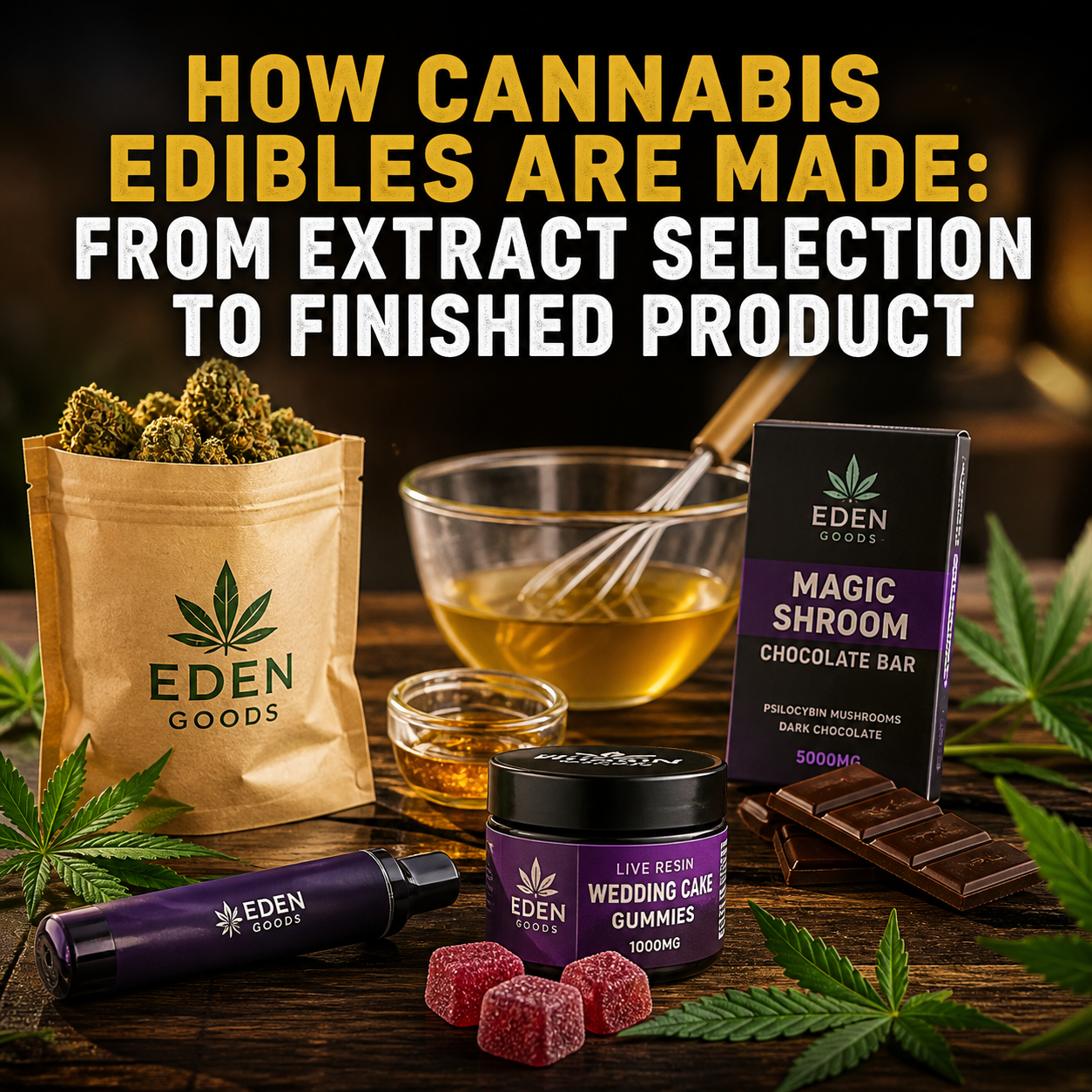
How Cannabis Edibles Are Made: From Extract Selection to Finished Product
Understanding how cannabis edibles are made can help consumers compare products, interpret labels, and recognize important quality indicators. The process involves much more than adding cannabis to a brownie or gummy. Licensed manufacturers must select a cannabinoid source, prepare a consistent formulation, control each production stage, test the finished batch, and package it responsibly.
Methods vary according to the product, manufacturer, and local regulations. A fruit gummy does not require the same formulation as chocolate, a beverage, or a capsule. However, most commercial products follow the same broad path: extraction or infusion, formulation, homogenization, portioning, testing, and packaging.
This guide explains that path without providing a home extraction recipe. Producing concentrated cannabis extracts can involve heat, pressure, volatile substances, or specialized equipment. It should only occur in an appropriately licensed and controlled facility where permitted by law.
What Is a Cannabis Edible?
A cannabis edible is a food, drink, lozenge, capsule, or similar ingestible product containing cannabinoids. These naturally occurring cannabis compounds include tetrahydrocannabinol, commonly called THC, and cannabidiol, known as CBD. Products may also contain minor cannabinoids, depending on their formulation.
THC can cause intoxication and impair judgment, coordination, and reaction time. CBD does not generally produce the same intoxicating effect, but it can still cause side effects and interact with medicines. A product described as hemp-derived is not automatically non-intoxicating. Its cannabinoid content and local legal classification matter more than the marketing term.
Common edible formats include:
- Gummies and soft chews
- Chocolate and confectionery
- Baked goods
- Hard candies and lozenges
- Beverages and drink mixes
- Oils, capsules, and softgels intended for oral use
Edibles differ from inhaled cannabis because cannabinoids pass through the digestive system before reaching the bloodstream. Effects can therefore take longer to appear and may last longer. This delay is one reason consumers should follow the product label and avoid taking more simply because they do not feel an immediate effect.
How Cannabis Edibles Are Made: The Main Stages
Commercial edible production combines cannabis processing with established food-manufacturing practices. Although equipment and recipes differ, the following stages describe the general workflow.
- Select the cannabis extract or infused ingredient.
- Confirm cannabinoid identity and concentration.
- Prepare the food or beverage base.
- Incorporate and evenly distribute the cannabinoids.
- Shape, cook, cool, or otherwise finish the product.
- Test the batch for potency, consistency, and contaminants.
- Package and label it according to applicable rules.
Each stage affects the final product. Poor raw materials cannot be corrected through attractive packaging, while inadequate mixing can create significant differences between portions from the same batch.
Stage 1: Selecting the Cannabinoid Source
The first major decision is the type of cannabis-derived ingredient. Manufacturers may use a refined extract, a broader-spectrum extract, or an infused food-compatible carrier. Selection depends on the desired cannabinoid profile, flavor, texture, appearance, stability, and legal requirements.
Distillate
Distillate is a highly refined extract with a concentrated cannabinoid content. Its relatively neutral flavor can make it suitable for gummies, chocolates, and other foods where a strong plant taste would be undesirable. THC distillate may be intoxicating, while CBD-dominant distillate is formulated around cannabidiol.
Refinement does not automatically prove quality. Reliable production still requires verified specifications, batch records, and laboratory testing.
Full-spectrum and broad-spectrum extracts
Full-spectrum extracts retain a wider range of cannabis compounds. Depending on the plant source and legal definition in the relevant jurisdiction, they may contain THC, CBD, minor cannabinoids, terpenes, and other plant constituents.
Broad-spectrum is generally used for extracts containing several cannabis compounds with THC removed or reduced to a specified level. Definitions and legal thresholds vary. Consumers should rely on the product label and a batch-specific certificate of analysis rather than assuming that every manufacturer uses these terms identically.
Isolate
An isolate contains one highly purified cannabinoid, such as CBD. It allows manufacturers to formulate around a defined ingredient and minimizes the plant flavor associated with less-refined extracts. However, an isolate is not inherently safer or more effective than every other format. Suitability depends on the person, intended use, product quality, and medical context.
| Ingredient type | Typical characteristics | Key point to verify |
| Distillate | Concentrated and relatively neutral in flavor | Measured cannabinoid concentration |
| Full-spectrum extract | Contains a broader range of plant compounds | Actual THC content and legal status |
| Broad-spectrum extract | Multiple compounds with THC removed or reduced | Batch results for residual THC |
| Isolate | One highly purified cannabinoid | Identity and purity |
| Infused carrier | Cannabinoids dispersed in an oil or another food ingredient | Uniformity and storage stability |
Stage 2: Cannabinoid Activation and Preparation
Raw cannabis can contain cannabinoid acids, such as THCA and CBDA. Controlled heating can convert these compounds into forms commonly found in finished products, including THC and CBD. This process is known as decarboxylation.
Manufacturers may activate the material before extraction, during processing, or through another validated production stage. The precise method depends on the equipment and desired chemical profile. Excessive or poorly controlled heat can degrade ingredients, affect flavor, or change cannabinoid composition.
Not every edible is designed around fully activated cannabinoids. Some specialist formulations intentionally retain acidic cannabinoids. The laboratory profile, rather than the product name alone, shows what the finished item contains.
Stage 3: Extraction and Refinement
If a manufacturer does not purchase a prepared ingredient, cannabinoids must be separated from the plant material. Commercial facilities use controlled systems selected for efficiency, purity, and regulatory compliance. Extraction may use food-grade ethanol, carbon dioxide, hydrocarbons in specialized closed systems, mechanical separation, or other approved technologies.
Each method creates a different starting extract. Further refinement may remove waxes, chlorophyll, solvent residues, or unwanted compounds. Distillation or other purification steps can increase cannabinoid concentration.
This part of production requires trained personnel and appropriate facilities. Solvent-based extraction should not be attempted in a home kitchen. Flammable vapors, pressure, contamination, and inaccurate potency create serious risks.
Stage 4: Creating the Food or Beverage Base
Once the cannabinoid ingredient is ready, manufacturers prepare the edible base. This stage resembles conventional food production, but the formulation must also protect cannabinoid stability and promote even distribution.
Gummies and chews
Gummies usually contain a gelling system, sweeteners, water, flavoring, acids, and color where permitted. Manufacturers must control moisture, acidity, texture, and cooling. These factors influence shelf life and prevent gummies from becoming excessively sticky, hard, or unstable.
Chocolate products
Chocolate requires careful temperature control to achieve the desired shine, snap, texture, and storage stability. Cannabinoid ingredients must integrate with the fat-containing base without forming concentrated pockets.
Baked goods
Baked products bring additional challenges. Heat exposure, moisture, fat content, portion size, and shelf life can influence the finished result. Commercial producers validate their process to determine whether cannabinoid levels remain consistent after baking.
Beverages
Cannabinoids are naturally more compatible with fats than water. Beverage manufacturers may therefore use emulsification technology to disperse very small droplets through a water-based drink. A stable emulsion helps limit separation and supports more consistent distribution.
Stage 5: Homogenization and Accurate Portioning
Homogenization is one of the most important answers to the question of how cannabis edibles are made. It means distributing the cannabinoid ingredient evenly throughout the mixture. Without adequate mixing, one gummy or chocolate square could contain more THC or CBD than another.
Manufacturers consider the viscosity of the mixture, mixing sequence, equipment, batch size, temperature, and time. They may collect samples from different areas of the batch to assess uniformity. Production records also help identify deviations before products reach consumers.
The mixture is then deposited, molded, cut, filled, or divided into individual servings. Portion weight and cannabinoid concentration must work together. A piece of the correct physical size may still be incorrectly formulated if the underlying mixture is uneven.
Stage 6: Finishing, Cooling, and Shelf-Life Control
After portioning, products may need to set, cool, dry, bake, coat, or cure. The finishing stage establishes texture and prepares the edible for packaging. Manufacturers also monitor conditions that can encourage microbial growth or cause quality to deteriorate.
Shelf-life assessment may consider:
- Cannabinoid stability over time
- Moisture and water activity
- Microbial risk
- Changes in flavor, color, and texture
- Packaging performance
- Exposure to heat, oxygen, and light
An expiration or best-before date should reflect product-specific information rather than guesswork. Consumers should follow the printed storage instructions. A damaged seal, unusual odor, visible mold, or significant change in appearance can indicate that the product should not be used.
Stage 7: Laboratory Testing and Quality Control
Testing requirements vary by jurisdiction, but reputable regulated production generally includes checks for cannabinoid potency and selected contaminants. Testing helps confirm that the product matches its label and meets applicable limits.
A testing program may assess:
- THC, CBD, and other cannabinoid concentrations
- Consistency between individual servings
- Microbial contamination
- Pesticide residues
- Heavy metals
- Residual extraction solvents where relevant
- Mycotoxins or other locally regulated contaminants
A certificate of analysis, often called a COA, summarizes laboratory findings for a particular batch. Consumers should check that its batch or lot number matches the package. The report should identify the laboratory, test date, sample, measured cannabinoids, and relevant contaminant results.
A generic report that does not correspond to the purchased batch provides limited reassurance. Laboratory testing also has limits. Results apply to the sample tested and depend on appropriate sampling, validated methods, and laboratory competence.
Stage 8: Packaging and Labeling
Packaging protects the edible from contamination, light, oxygen, moisture, and physical damage. Where required, manufacturers use child-resistant or tamper-evident packaging. No package is completely childproof, so secure storage remains essential.
A useful label should clearly state:
- The cannabinoids present
- The amount per serving and per package
- The serving size
- The ingredient and allergen information
- The batch or lot number
- The expiration or best-before date
- Storage instructions
- Required warnings and manufacturer details
Packaging should not make an intoxicating product look like ordinary candy, especially when children may be present. Keep cannabis edibles in their original labeled container and store them separately from everyday food.
How Commercial and Homemade Edibles Differ
| Consideration | Regulated commercial product | Homemade product |
| Potency | May undergo batch testing and label verification | Difficult to measure without laboratory analysis |
| Uniformity | Produced with controlled mixing and portioning | Can vary substantially between portions |
| Contaminants | May be tested under local requirements | Usually not independently tested |
| Labeling | Includes batch, ingredient, and cannabinoid information | Often limited or absent |
| Packaging | May include child-resistant and tamper-evident features | Often uses standard food containers |
Commercial status does not guarantee that every product is high quality. Oversight differs between regions, and unregulated products may imitate licensed packaging. Consumers should buy only through lawful channels and verify batch information where possible.
Safety Considerations Before Using Cannabis Edibles
Edibles require caution because their effects are delayed and can persist. Never drive, cycle in traffic, operate machinery, or perform safety-sensitive tasks after consuming an intoxicating cannabis product.
Keep all cannabis products locked away from children, teenagers, pets, and adults who could mistake them for ordinary food. If a child or pet consumes an edible, contact local emergency, poison-control, or veterinary services promptly. Severe drowsiness, breathing difficulty, collapse, confusion, chest pain, seizures, or loss of consciousness require urgent medical help.
Speak with a doctor or pharmacist before using cannabis if you:
- Take prescription or non-prescription medicines
- Are pregnant, planning pregnancy, or breastfeeding
- Have heart, liver, kidney, neurological, or mental health concerns
- Have experienced problematic substance use
- Are older, frail, or at increased risk of falls
Cannabis can interact with medicines and may not be appropriate in every situation. Product information cannot replace personalized medical advice.
Frequently Asked Questions About How Cannabis Edibles Are Made
Are cannabis edibles made directly from the plant?
Some begin with plant material, but commercial producers commonly use an extract, isolate, distillate, or infused carrier. The ingredient is incorporated into a food or beverage base and divided into portions.
Why are cannabis edibles heated?
Controlled heat may activate cannabinoids and is also part of normal food production. Manufacturers must manage heat carefully because excessive exposure can affect potency, flavor, and product quality.
How do manufacturers make each edible consistent?
They use measured ingredients, controlled mixing, calibrated portioning equipment, in-process checks, and laboratory testing. These steps help distribute cannabinoids evenly throughout the batch.
Do all cannabis edibles contain THC?
No. Some contain CBD isolate or broad-spectrum ingredients with no detectable THC under a specific test. Others contain enough THC to cause intoxication. Always check the current batch label and COA.
What does full-spectrum mean on an edible label?
It generally means the extract retains several cannabis compounds. The term does not have one universal definition, so verify the listed cannabinoids and THC content.
How long do edible effects take to begin?
Onset varies according to the product, meal timing, metabolism, and individual factors. Effects are often delayed compared with inhalation. Follow the label and do not take more while waiting for an effect.
Can a certificate of analysis prove an edible is safe?
A matching batch report provides useful information about potency and tested contaminants. It cannot eliminate every risk or replace appropriate manufacturing, storage, legal compliance, and medical guidance.
Conclusion
Knowing how cannabis edibles are made reveals why extract selection, activation, formulation, homogenization, testing, and packaging all matter. A dependable product requires more than a recognizable flavor or an appealing package. It needs traceable ingredients, consistent portions, clear labeling, and responsible quality control.
Choose products only from lawful sources, confirm the cannabinoid amount per serving, and look for batch-specific test information. Store edibles securely and discuss cannabis with a healthcare professional when medicines, pregnancy, chronic illness, frailty, or fall risk may affect safety.
For separate day-to-day continence and home-care needs, discover the range of Sphère Santé products, including practical solutions selected to support comfort, dignity, and everyday confidence. [[LIEN_INTERNE: protections anatomiques]] [[LIEN_INTERNE: slips absorbants]] [[LIEN_INTERNE: alèses]]