

Blog
Cannabis Bud Density Explained: What Dense or Loose Flower Really Tells You

Cannabis Bud Density Explained: What Dense or Loose Flower Really Tells You
Cannabis bud density describes how tightly a flower’s plant material is packed. Some buds feel compact, firm, and heavy for their size. Others have an open, airy structure with more visible space between the leaves and calyxes.
Density can offer useful clues about genetics, growing conditions, trimming, moisture, and handling. However, it does not provide a complete measure of quality. A dense bud is not automatically potent, flavorful, or well grown. Loose flower is not necessarily weak or inferior.
To evaluate cannabis flower accurately, consider density alongside aroma, trichome coverage, moisture balance, cleanliness, and reliable product information. This guide explains what cannabis bud density can tell you, what it cannot reveal, and how to compare different flowers without relying on appearance alone.
What Is Cannabis Bud Density?
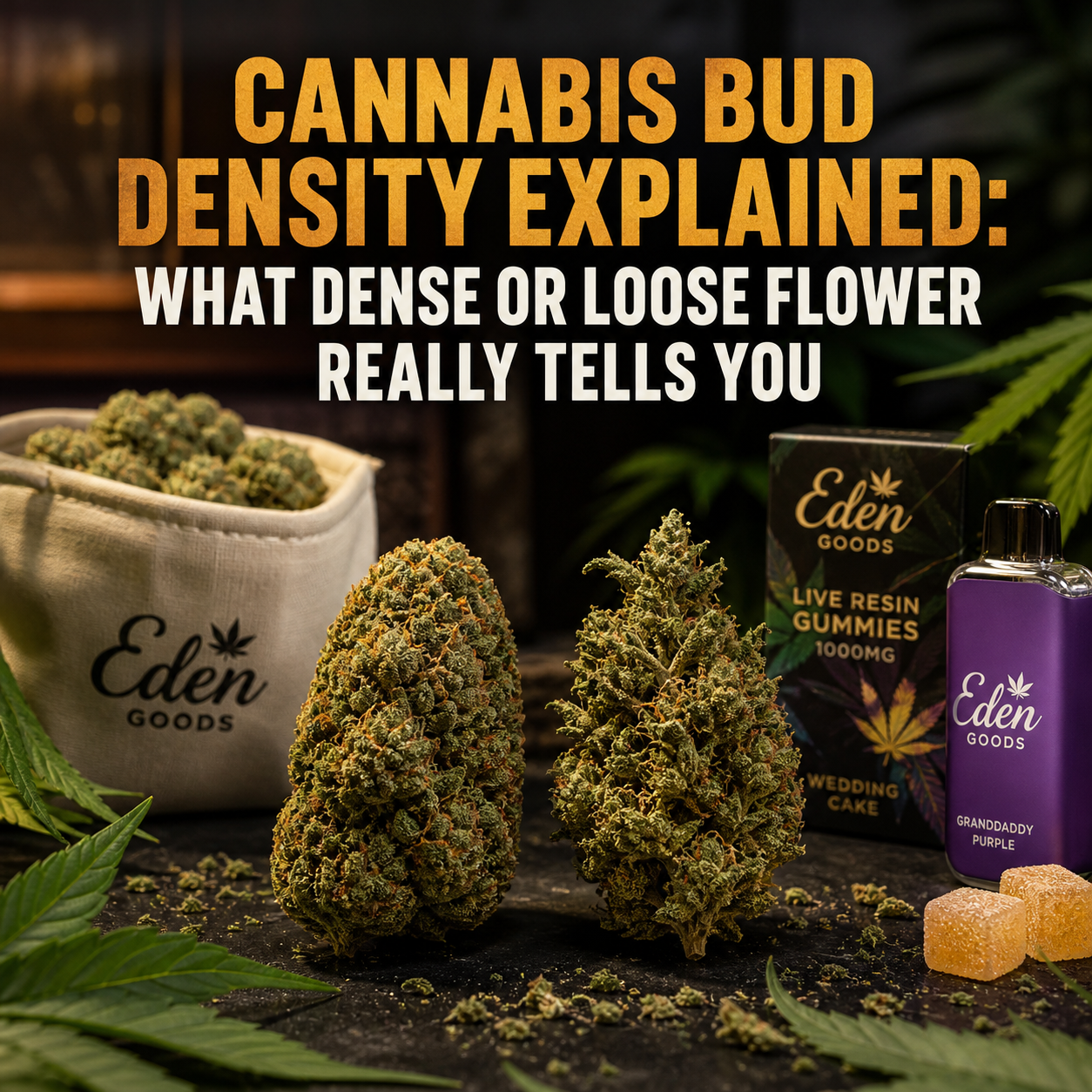
Bud density refers to the amount of plant material concentrated within a flower’s visible volume. A compact bud contains tightly clustered floral structures. An airy bud has a looser arrangement, often with more space around individual calyxes and small leaves.
Density exists on a spectrum. It is not limited to two fixed categories. One flower may be extremely hard and compact, while another feels moderately firm but still separates easily. Some naturally loose flowers remain well formed and resinous.
Growers sometimes discuss density in relation to flower weight per unit of space. Consumers usually judge it by sight and touch. A dense gram of cannabis may look smaller than a gram of loose flower because the same weight occupies less room.
Dense cannabis buds
Dense buds often have a rounded or chunky shape. Their calyxes sit close together, and the flower may resist light pressure. Compact flowers can feel heavier than expected when compared with their size.
Loose or airy cannabis buds
Loose buds tend to look longer, softer, or more open. Individual floral structures and small leaves may be easier to distinguish. They often occupy more space in a container at the same weight.
| Characteristic | Dense flower | Loose flower |
| Visual structure | Compact and tightly clustered | Open and visibly layered |
| Apparent size by weight | Often looks smaller | Often looks larger |
| Feel | Firm or solid | Soft or easy to separate |
| Typical airflow during growth | More limited within the flower | Greater between floral structures |
| Quality implication | Not conclusive | Not conclusive |
Does Cannabis Bud Density Indicate Quality?
Density alone does not determine cannabis quality. Consumers often associate firm buds with premium flower because compact products can look carefully cultivated and may withstand packaging well. Yet this visual preference can be misleading.
A dense flower may have weak aroma, excess moisture, poor flavor, or hidden microbial damage. It may also have been compressed during packaging. Conversely, a loose flower can have abundant trichomes, a distinctive terpene profile, and a balanced cure.
Quality depends on several characteristics working together:
- Aroma that matches the cultivar and does not smell musty or chemical
- Visible trichomes rather than a dull or excessively handled surface
- Balanced moisture without wetness or extreme brittleness
- No visible mold, web-like growth, pests, or unusual discoloration
- Appropriate trimming without excessive leaves or bare stems
- Verified labeling and testing where regulated products are available
Potency also cannot be judged through density. Cannabinoid and terpene content depend on genetics, plant development, harvest timing, processing, and storage. Laboratory information from a properly regulated source is more useful than firmness when comparing labeled products.
What Determines Cannabis Bud Density?
Cannabis bud density develops through an interaction of genetics and environment. The flower’s natural structure provides a starting point, while cultivation and post-harvest practices influence the final result.
Genetics and cultivar structure
Genetics play a major role. Some cultivars naturally develop compact clusters. Others produce elongated or open flowers even under skilled cultivation. This is why comparing two unrelated cultivars by density alone is rarely fair.
The familiar labels indica and sativa are sometimes used to predict flower structure. They are not reliable quality standards, and many modern cultivars have mixed ancestry. Cultivar-specific traits and actual growing conditions provide more meaningful context.
Light exposure
Light supports plant growth and flower development. Insufficient or uneven exposure may contribute to smaller, less developed flowers. Buds lower on a plant often receive less light and may remain looser than flowers near the top.
More light is not always better. Excessive light or heat can stress the plant. Professional cultivation requires an appropriate balance based on the plant, growth stage, and environment.
Temperature and humidity
Environmental conditions can affect how flowers form. Excess heat may interfere with normal development and contribute to stretched or airy growth. Humidity management is particularly important around compact flowers because moisture can become trapped inside them.
Dense buds require careful airflow and environmental control during cultivation. Their closed structure may make internal problems harder to notice. Loose flowers generally allow more air to circulate, although they can still develop mold under unsuitable conditions.
Plant nutrition and health
A plant needs balanced nutrition to develop normally. Deficiencies, excess nutrients, root problems, pests, and other stressors may reduce flower development. However, consumers cannot reliably diagnose a cultivation issue by looking at density alone.
An airy structure may simply reflect genetics. Similarly, compact flower does not prove that a plant received ideal care.
Harvest timing
Flowers harvested before full development may be smaller or less substantial. Harvesting later does not automatically create better density, however. Timing affects multiple characteristics, including trichome maturity, aroma, and the condition of the flower.
Responsible growers consider the overall maturity of the plant rather than using size or firmness as their only signal.
Drying and curing
Freshly harvested cannabis contains considerable moisture. Drying removes much of it, while curing helps moisture redistribute through the flower under controlled conditions. Both stages affect texture, aroma, stability, and the way a bud feels.
Flower dried too aggressively may become brittle and lose aromatic intensity. Flower packaged while too wet can feel unusually heavy or soft and may be more vulnerable to microbial growth. A dense bud that feels damp should not be mistaken for a high-quality product.
Trimming, handling, and compression
Machine trimming can create a rounded, uniform appearance. Hand trimming may preserve more of the flower’s original shape. Neither method guarantees quality.
Pressure during storage and transport can also make buds look flatter or more compact. Vacuum sealing and tight packaging may compress loose flower without changing its genetics or chemical composition. Apparent density therefore does not always reflect how the flower grew.
How to Assess Cannabis Bud Density and Overall Quality
If handling is permitted, use gentle pressure rather than squeezing or crushing the flower. A well-stored bud often has slight resilience. It should not feel wet, spongy, rock-hard from compression, or so dry that it immediately turns to powder.
Follow a broader assessment instead of treating firmness as a pass-or-fail test.
- Check the structure. Note whether the flower is naturally compact, moderately firm, or open. Look for crushed areas and oversized stems.
- Inspect the surface. Trichomes may appear as fine, sparkling resin glands. They should not be confused with fuzzy, cotton-like, or web-like material.
- Consider moisture. The flower should not feel damp. Extreme dryness can also reduce aroma and create a harsh texture.
- Smell carefully. Expected aromas vary widely. Musty, mildew-like, ammonia-like, or otherwise abnormal odors are warning signs.
- Review the label. In regulated markets, check packaging dates, testing details, cannabinoid information, and storage guidance.
Avoid consuming flower that shows suspected mold or contamination. Do not try to remove only the visibly affected section. Contamination may extend beyond what you can see. If exposure causes concerning symptoms, seek advice from a qualified healthcare professional.
Dense Versus Loose Flower: Practical Differences
Density can change how cannabis looks, breaks apart, and fits inside a container. It can also influence how easily moisture and air move through the flower. These practical differences matter, but they should not become automatic judgments about value.
| Consideration | Dense buds | Loose buds |
| Breaking apart | May require more effort or a grinder | Often separates more easily |
| Visual volume | Less volume at the same weight | More volume at the same weight |
| Internal inspection | Problems may remain hidden inside | Inner surfaces may be easier to see |
| Moisture movement | Can be less even through thick flowers | May dry more quickly |
| Transport | Can remain intact but may be compressed | May flatten or shed small pieces |
Dense flower may expand more than expected after grinding. Loose flower may appear generous in the package but still weigh exactly as labeled. Visual volume is not a dependable way to estimate quantity. A calibrated commercial scale and compliant labeling offer a better reference.
Can a Cannabis Bud Be Too Dense?
Natural compactness is not a defect. The concern arises when density combines with excess moisture, inadequate airflow, or poor storage. Thick flowers can retain moisture internally, creating conditions that may support mold.
Extremely hard buds may also have been compressed. In some cases, unusually heavy or rigid flower can raise questions about retained moisture or processing. Appearance alone cannot confirm the cause.
Break dense buds open before use and inspect the center under good light. Watch for gray, white, brown, or black areas that look inconsistent with normal plant tissue. A musty smell, fuzzy growth, or fine web-like strands should be treated cautiously. Trichomes look crystalline and glandular rather than fluffy.
Does Loose Cannabis Flower Mean It Was Poorly Grown?
No. Loose flower may reflect genetics, a naturally elongated structure, or its position on the plant. Certain cultivars do not produce tight, rounded buds even when growers manage them carefully.
Environmental stress can also cause airy flowers, so structure may provide context when combined with other signs. For example, loose flower with very weak aroma, incomplete development, many leaves, and poor trimming may suggest lower overall quality. Loose flower with clear trichomes, a fresh aroma, and balanced moisture may be excellent.
The most useful comparison is between batches of the same cultivar from reliable producers. Even then, harvest conditions and post-harvest handling can create differences.
How Cannabis Bud Density Affects Grinding and Use
Compact buds often produce more ground material than their small appearance suggests. Break them into smaller pieces before placing them in a grinder. This reduces strain on the grinder and makes it easier to inspect the interior.
Loose flowers may grind quickly and can become powdery if overdried. Gentle handling helps preserve trichomes and limits unnecessary fragmentation.
Density does not predict how a product will affect an individual. Effects can vary with cannabinoid concentration, terpene composition, amount used, route of administration, tolerance, medications, and personal health factors. Start cautiously where adult cannabis use is legal, and follow the labeled directions for regulated products.
Storing Dense and Loose Cannabis Flower
Store cannabis in a clean, airtight container away from direct light, heat, and excessive moisture. Keep the container in a stable, cool location. Avoid bathrooms, vehicles, and sunny windowsills, where temperature and humidity can change quickly.
Do not pack dense buds tightly together. Leaving reasonable space reduces crushing and makes periodic inspection easier. Loose flower should also be protected from repeated handling and excessive airflow, which can accelerate drying.
- Keep cannabis in its original child-resistant packaging when required.
- Store it securely away from children and pets.
- Do not add fruit peels, bread, or other household materials to restore moisture.
- Follow any product-specific storage instructions on the label.
- Discard flower that develops suspicious odor, growth, or discoloration.
Choosing Flower Without Overvaluing Density
When buying cannabis flower legally, avoid choosing solely by how large or hard the buds appear. Start with product transparency. A trustworthy label should clearly identify the product and provide the information required in your jurisdiction.
Then consider freshness, cultivar characteristics, aroma, trichome condition, moisture, and intended use. Price should reflect the complete product rather than a single visual feature.
Online photographs can be useful, but lighting, camera distance, and image editing affect appearance. Product descriptions that call buds dense or chunky describe structure, not guaranteed potency. Look for precise information and avoid claims that promise a particular medical result.
Health, Legal, and Safety Considerations
Cannabis laws differ by location. Purchase, possess, and use cannabis only where permitted, and use regulated sources when available. Never drive or operate machinery while impaired. Keep all cannabis products out of reach of children and animals.
Cannabis may cause unwanted effects and can interact with certain medicines. Risks vary according to age, pregnancy status, underlying conditions, product strength, and method of use. If you use prescription medication, have a health condition, are pregnant or breastfeeding, or are considering cannabis for symptoms, speak with a qualified healthcare professional.
Bud density cannot establish safety, purity, or medical suitability. Laboratory testing, responsible labeling, careful storage, and professional guidance provide more meaningful protection.
Frequently Asked Questions About Cannabis Bud Density
Are dense cannabis buds better than fluffy buds?
Not necessarily. Dense buds can be attractive and compact, but loose flower may be equally aromatic, resinous, and well cultivated. Evaluate the complete product rather than firmness alone.
Does bud density mean higher THC?
No. Density does not reliably predict THC or other cannabinoid levels. Use verified laboratory information from a regulated product when available.
Why does one gram of dense flower look small?
Dense plant material occupies less space. A compact gram can therefore look smaller than the same weight of airy flower.
Why are some cannabis buds light and airy?
Genetics, light exposure, temperature, plant health, flower position, and harvest timing can all influence structure. Airiness alone does not prove poor cultivation.
Can dense buds contain mold?
Yes. Their tight structure may trap moisture and make internal contamination harder to see. Break the flower open and avoid using it if you notice suspicious growth or odor.
Do dense buds last longer in storage?
Not automatically. Longevity depends on moisture, temperature, light, air exposure, packaging, and initial product condition. Both dense and loose flowers require careful storage.
Can packaging make cannabis appear denser?
Yes. Pressure, tight containers, or vacuum sealing can compress flowers. This changes their shape but does not necessarily improve their quality or potency.
Conclusion
Cannabis bud density is one useful physical characteristic, not a final quality grade. Dense flower may reflect genetics and strong development, but it can also hide excess moisture or result from compression. Loose flower may be naturally structured, flavorful, and rich in trichomes despite its airy appearance.
For a reliable assessment, combine density with aroma, moisture balance, cleanliness, trichome condition, labeling, and storage history. Cannabis bud density tells part of the story. The best choices come from examining the whole flower and purchasing responsibly from legal, transparent sources.