


Blog
Solventless vs Solvent-Based Concentrates: Methods, Flavour and Product Choice

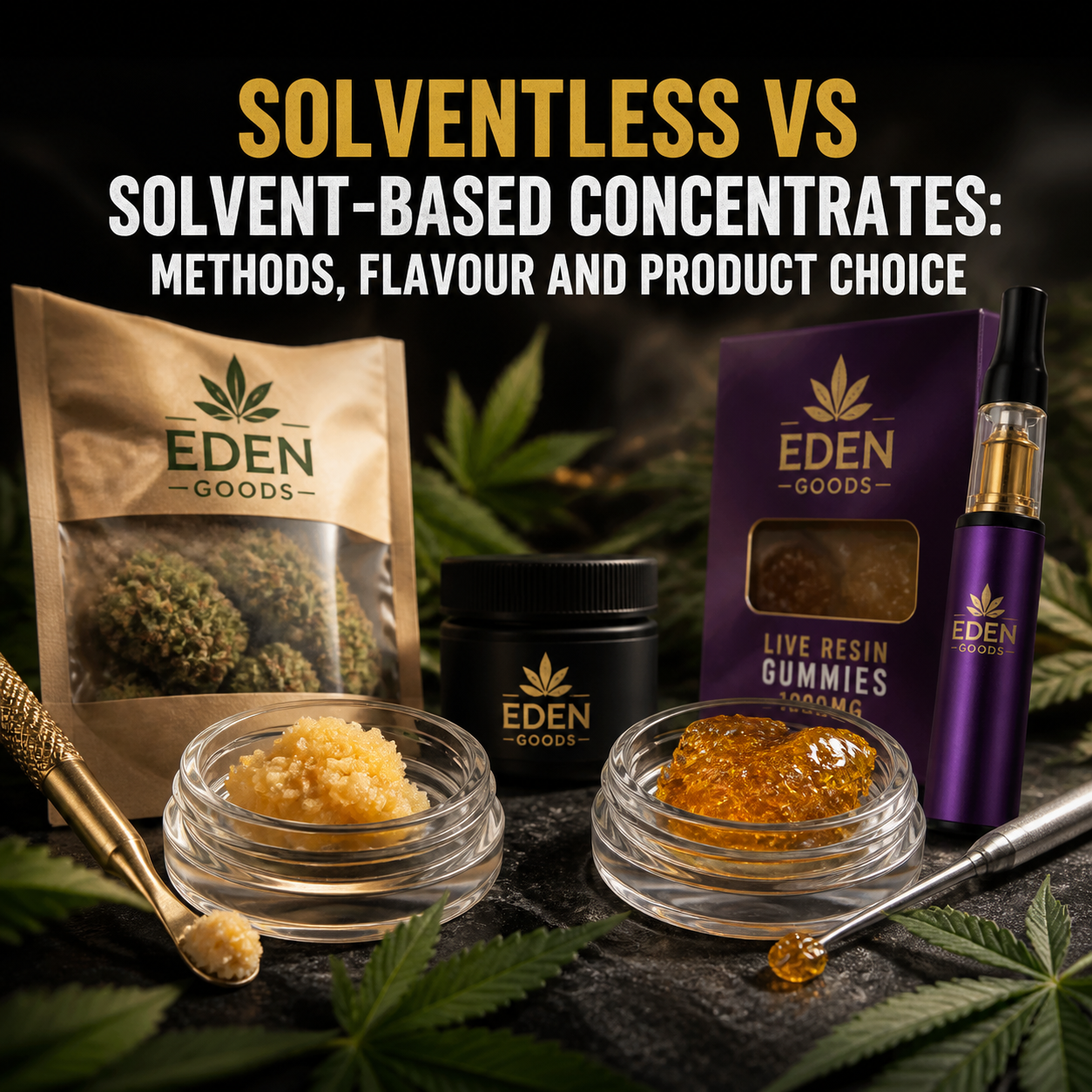
Solventless vs Solvent-Based Concentrates: Methods, Flavour and Product Choice
Choosing between solventless vs solvent-based concentrates is not simply a matter of deciding which type is stronger. The extraction method can influence flavour, aroma, texture, cannabinoid concentration, price and product consistency. Quality also depends on the starting material, the skill of the producer and independent laboratory testing.
Solventless concentrates use mechanical separation, temperature or pressure rather than a chemical processing solvent. Common examples include dry sift, ice-water hash and rosin. Solvent-based extraction uses substances such as hydrocarbons, ethanol or carbon dioxide to separate desired compounds from cannabis material. Live resin, certain oils and many refined extracts fall within this broad group.
Neither category is automatically best for every person. Solventless products often appeal to buyers who value minimal processing and a close expression of the original plant. Solvent-based products can offer greater consistency, a wide range of textures and efficient extraction. The right choice depends on your priorities and the quality controls behind the specific product.
[[LIEN_INTERNE: cannabis concentrates]]
What Is the Difference Between Solventless and Solvent-Based Concentrates?
The main difference lies in how producers separate trichomes and their compounds from the cannabis plant. Trichomes are the small resin-producing structures that contain cannabinoids and aromatic compounds, including terpenes.
Solventless processing removes or presses these resin glands through physical means. Solvent-based processing dissolves selected compounds into a processing solvent before separating that solvent from the finished extract under controlled conditions.
| Comparison point | Solventless concentrates | Solvent-based concentrates |
| Basic method | Mechanical separation, filtration, heat or pressure | Extraction with hydrocarbons, ethanol, carbon dioxide or another processing solvent |
| Common examples | Dry sift, ice-water hash, hash rosin, flower rosin | Live resin, cured resin, hydrocarbon extracts, ethanol extracts and many oils |
| Typical appeal | Minimal processing and plant-character flavour | Consistency, scalability and varied product formats |
| Potential limitation | Lower yields, variable melt quality and higher prices | Requires professional solvent removal and residual-solvent testing |
| Quality depends on | Freshness, trichome quality, separation and pressing skill | Starting material, solvent selection, equipment, refinement and testing |
The term solventless can cause confusion because ice-water hash uses water. In cannabis terminology, water serves mainly as a medium for mechanically separating brittle trichomes. Producers therefore classify the method as solventless, even though water can act as a solvent in other scientific contexts.
How Solventless Cannabis Concentrates Are Made
Solventless production aims to collect resin without using hydrocarbons, ethanol or similar extraction agents. The method may sound simple, but producing a clean and flavourful concentrate requires careful control of temperature, moisture, pressure and handling.
Dry Sift
Dry sift is made by passing dried cannabis material across fine screens. The process separates trichome heads from larger pieces of plant material. Screen size, temperature and gentle handling affect the final quality.
High-grade dry sift contains a large proportion of intact resin heads and little visible plant matter. Lower grades may contain more leaf fragments and may not melt as evenly. Appearance alone cannot confirm purity or potency, so regulated laboratory results still matter.
Ice-Water Hash
Ice-water hash, sometimes called bubble hash, uses cold water, ice and agitation to detach trichomes. Filter bags with different mesh sizes collect resin glands according to their dimensions. The collected material then needs thorough drying to reduce the risk of unwanted microbial growth.
Some premium grades are described as full melt because they can melt with minimal residue under suitable conditions. However, terms such as full melt are not always standardised. Buyers should treat them as product descriptions rather than guarantees.
Rosin
Rosin is produced by applying controlled heat and pressure to cannabis flower, dry sift or hash. The resinous material flows away from the starting material and is collected without a chemical processing solvent.
Flower rosin comes directly from dried flower. Hash rosin uses previously separated trichomes, often from ice-water hash. Hash rosin usually requires more processing and starting material, which helps explain its higher retail price.
Fresh-frozen cannabis may be washed and pressed to produce live rosin. Freezing the harvested plant promptly can help preserve volatile aromatic compounds, but the final result still depends on cultivar, harvest timing, storage and producer skill.
How Solvent-Based Cannabis Concentrates Are Made
Solvent-based extraction uses a substance capable of separating cannabinoids, terpenes and other compounds from plant material. Licensed facilities employ closed equipment, controlled temperatures and validated procedures. They then remove the processing solvent and test the finished product against applicable limits.
Hydrocarbon Extraction
Butane and propane are common hydrocarbon solvents in commercial cannabis extraction. They can efficiently collect cannabinoids and aromatic compounds at relatively low temperatures. Producers may adjust the solvent blend and processing conditions to influence extraction efficiency and final texture.
Hydrocarbon extraction can produce live resin, cured resin, sauce, badder, budder and other consistencies. These names usually describe texture, source material or post-extraction handling. They do not prove that one product is safer or better than another.
Hydrocarbon extraction should never be attempted at home. Butane and propane are highly flammable. Improvised extraction can cause fire, explosion, serious injury and uncontrolled solvent exposure.
Ethanol Extraction
Ethanol can extract cannabinoids efficiently at commercial scale. Depending on temperature and processing conditions, it may also collect chlorophyll, waxes and other plant components. Additional filtration and refinement may therefore be used to produce the intended result.
Ethanol extracts can become oils, refined ingredients or inputs for formulated products. The degree of refinement varies. A highly refined extract may have less of the original plant aroma than a concentrate designed to retain a broad terpene profile.
Carbon Dioxide Extraction
Carbon dioxide extraction uses CO2 under carefully controlled pressure and temperature. In a supercritical or subcritical state, CO2 can act as an extraction medium. This method requires specialised equipment and technical expertise.
CO2 does not leave the same type of residual organic solvent as butane or ethanol because it returns to a gaseous state. However, the process is still commonly grouped with solvent-based extraction because carbon dioxide functions as the processing solvent.
Distillate Is a Refinement, Not a Single Extraction Method
Distillate is often discussed alongside solvent extracts, but distillation is a refinement process. Producers concentrate selected cannabinoids by using differences in volatility under controlled conditions. The original extract used as feedstock may have been produced in more than one way.
Distillate can provide consistent cannabinoid content and a neutral base for formulated products. Its aroma may come from terpenes added after distillation rather than the complete aromatic profile of the original plant. Check the label if terpene origin matters to you.
Solventless vs Solvent-Based Concentrates for Flavour
Flavour is one of the main reasons buyers compare solventless vs solvent-based concentrates. Yet extraction category alone does not determine the tasting experience. Genetics, plant health, harvest maturity, storage and processing temperatures all influence aroma.
Well-made live rosin can deliver a complex profile that closely reflects the fresh plant. It often attracts consumers who value cultivar-specific character and minimal post-extraction refinement. Poorly stored or overheated rosin, however, may lose volatile terpenes and develop a duller aroma.
Live resin can also preserve a strong and distinctive terpene profile. It starts with fresh-frozen plant material and uses a solvent-based process at low temperatures. A carefully produced live resin may taste more expressive than a low-grade solventless product.
In practice, consider the following factors:
- Whether the product uses fresh-frozen or dried plant material
- The date of production or packaging
- Storage conditions before purchase
- The producer’s experience with the extraction method
- The listed terpene profile, where regulated testing provides it
- Whether flavouring agents or externally sourced terpenes were added
Descriptions such as fruity, gassy, floral or earthy remain subjective. Laboratory terpene results can provide context, but they cannot fully predict how a product will smell or taste to an individual.
Does Solventless Mean Cleaner or Safer?
Solventless does not automatically mean contaminant-free. Cannabis plants and concentrates may contain pesticides, microbes, heavy metals or foreign material if cultivation, processing and storage controls are inadequate. Ice-water hash also needs proper drying because retained moisture can create quality problems.
Likewise, the use of a solvent does not automatically make a regulated concentrate unsafe. Reputable manufacturers remove processing solvents according to controlled procedures. Accredited laboratories can then measure residual solvents and screen for other contaminants under local rules.
Marketing words such as clean, pure and natural have no universal meaning. A more reliable assessment considers traceable ingredients, legal production, batch-specific test results and appropriate packaging.
Concentrates can contain high levels of THC regardless of extraction method. High-THC products may cause anxiety, dizziness, impaired coordination, rapid heart rate or other unwanted effects in some people. They can also affect judgement and driving ability. Keep all cannabis products away from children and pets, and follow local laws.
If you are pregnant, breastfeeding, taking medication, living with a heart or mental health condition, or using cannabis for symptoms, it is recommended to speak with a qualified healthcare professional. Product information cannot replace individual medical advice.
Potency, Yield, Texture and Price
Potency
Both categories can produce highly concentrated products. Solventless does not necessarily mean lower potency, and solvent-based does not always mean stronger. The cannabinoid percentage depends on the material, process and degree of refinement.
A higher THC number does not guarantee better quality. It also says little about flavour, freshness, texture or the overall balance of compounds. Choose according to verified product information rather than potency alone.
Yield and Price
Solventless methods often produce lower yields from the same quantity of plant material. Premium hash rosin also requires suitable cultivars, careful washing, drying and pressing. These factors can increase production costs and retail prices.
Solvent-based extraction can process material efficiently and at larger scale. This may support more consistent availability and a broader price range. Equipment, laboratory testing, skilled staff and regulatory compliance still represent significant costs.
Texture
Concentrates may be sold as rosin, resin, sauce, sugar, wax, shatter, badder or oil. Texture can change through temperature control, agitation, crystallisation and storage. It is not a dependable shortcut for identifying extraction quality.
For example, badder describes a soft, whipped consistency. It does not reveal whether the product started as live material, which solvent was used or how thoroughly the batch was tested. Read the full label rather than relying on the product name.
Live Rosin vs Live Resin: A Common Source of Confusion
Live rosin and live resin sound similar, but they belong to different extraction categories. Both commonly begin with fresh-frozen cannabis, which may help retain volatile aromatic compounds that can diminish during drying and curing.
| Feature | Live rosin | Live resin |
| Extraction category | Solventless | Solvent-based |
| Typical process | Ice-water separation followed by heat and pressure | Usually hydrocarbon extraction in professional equipment |
| Starting material | Usually fresh-frozen cannabis | Fresh-frozen cannabis |
| Typical price | Often higher because of yield and labour | Often available across a wider price range |
| Main appeal | Minimal processing and rich plant character | Strong aroma, consistency and varied textures |
Neither word guarantees freshness. Check packaging dates and storage instructions. Heat, air and light can affect both products after production.
How to Choose the Right Concentrate
A useful product choice starts with your priorities rather than a claim that one extraction family is universally superior. Consider flavour, budget, ingredient transparency, legal availability and your tolerance for concentrated cannabinoids.
- Confirm the extraction method. Look for specific information such as hash rosin, hydrocarbon extraction, ethanol extraction or CO2 extraction.
- Read the complete ingredient list. Check for carrier oils, flavourings, botanical terpenes or other added ingredients.
- Review batch testing. Where available, verify cannabinoid results, residual-solvent testing and contaminant screening from a qualified laboratory.
- Check traceability. A batch or lot number should connect the package to relevant production and testing records.
- Consider freshness. Packaging dates and suitable storage can matter greatly for terpene-rich concentrates.
- Do not shop by THC alone. Potency is only one aspect of quality and may increase the likelihood of unwanted effects.
- Choose a legal, reputable retailer. Unregulated products may lack dependable manufacturing controls, accurate labels or meaningful testing.
A certificate of analysis can be useful, but it should match the product name and batch number. Check the test date and laboratory identity. A generic report that cannot be linked to the package offers limited reassurance.
[[LIEN_INTERNE: concentrate product guides]]
Storage and Responsible Handling
Heat, oxygen, light and repeated temperature changes can alter concentrate texture and aroma. Keep the product in its original, properly closed container. Follow the storage directions on the label because suitable conditions vary by formulation and packaging.
Always store concentrates in a secure place that children and pets cannot access. Do not transfer them into food containers or unlabelled jars. Concentrates may resemble sweets, honey or cosmetic products, which can increase the risk of accidental exposure.
Use only products intended for the device or route stated by the manufacturer. Do not place an extract into a vaporiser, edible recipe or other format unless its label specifically supports that use. Ingredients suitable for one product type may not be suitable for another.
Frequently Asked Questions
Are solventless concentrates always better?
No. They can offer minimal processing and expressive flavour, but quality still depends on the cannabis, production technique, storage and testing. A well-made solvent-based extract may outperform a poorly produced solventless one.
Do solvent-based concentrates contain butane?
Some are extracted with butane or a butane-propane blend. Licensed producers remove the solvent under controlled conditions. Batch testing should confirm that any residue meets the limits required in the relevant market.
Is rosin the same as resin?
No. Rosin is made with heat and pressure without a chemical processing solvent. Resin is a broader term, while live resin usually refers to a solvent-extracted concentrate made from fresh-frozen cannabis.
Which type has more flavour?
Both live rosin and well-made live resin can have strong flavour. Cultivar, freshness, terpene preservation and storage often matter more than the solventless or solvent-based label alone.
Which concentrate is more potent?
Either category can be highly potent. Refined solvent-based extracts may reach high cannabinoid concentrations, while quality hash rosin can also contain substantial THC. Review verified batch results rather than making assumptions.
Can I make solvent-based concentrate at home?
No home hydrocarbon extraction method can be recommended. Flammable solvents can cause explosions, fires and serious injuries. Choose products manufactured and tested by appropriately licensed professionals.
Why is hash rosin often expensive?
Hash rosin may require premium starting material, cold handling, ice-water separation, careful drying and pressing. Relatively low yields and labour-intensive production can increase its price.
Conclusion
The comparison of solventless vs solvent-based concentrates is more nuanced than natural versus chemical or flavour versus potency. Solventless methods rely on physical separation, heat and pressure. Solvent-based methods use controlled extraction media and require effective solvent removal, professional equipment and appropriate testing.
Choose solventless if minimal processing and plant-specific character are your main priorities. Consider a tested solvent-based product if you value consistency, format variety or a wider price range. In both cases, focus on legal sourcing, batch traceability, transparent ingredients and responsible storage.
Explore the concentrate selection available from Eden Goods to compare product formats and find clear information suited to your preferences. For other everyday wellbeing and personal-care needs, you can also discover the Sphère Santé product range.