

Blog
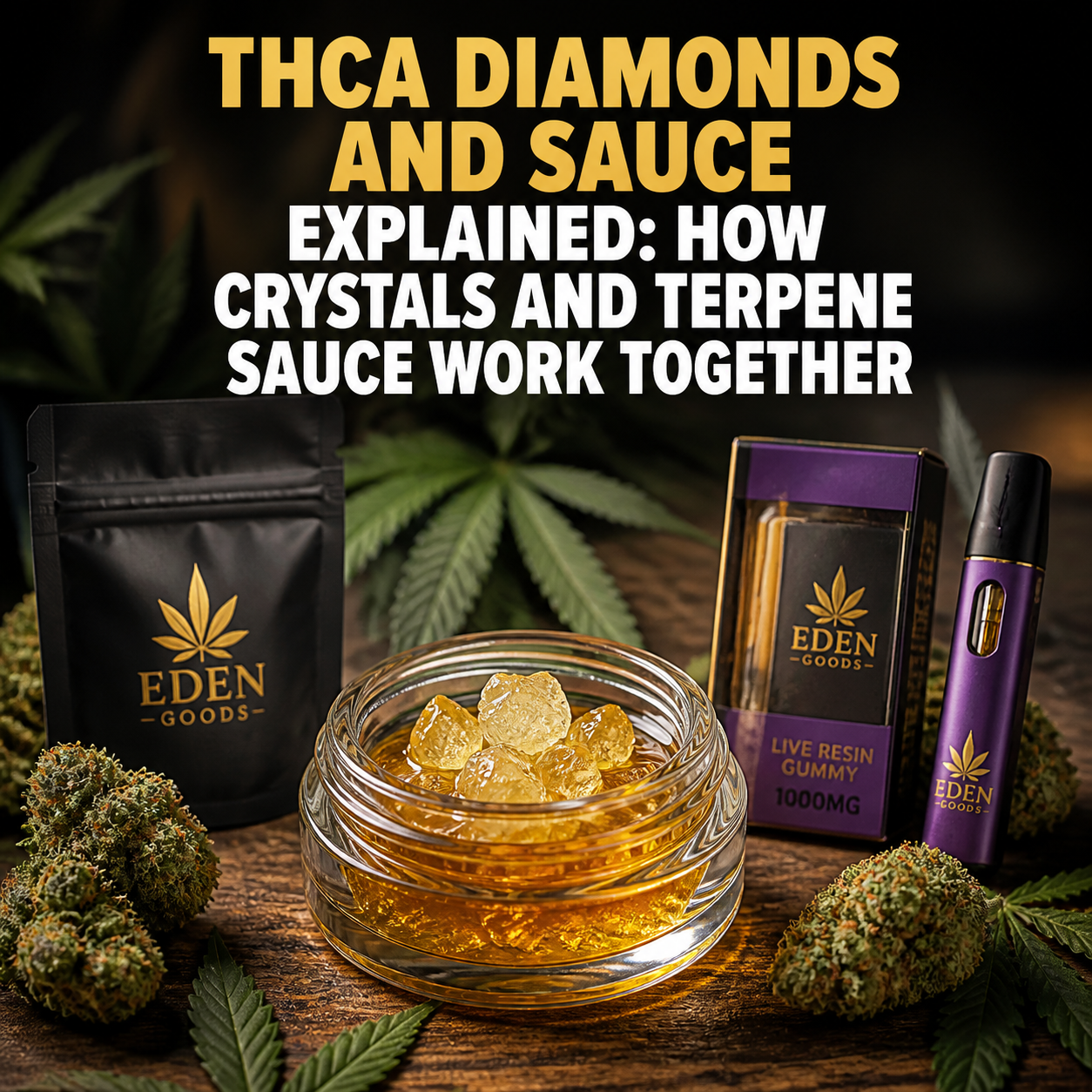
THCA Diamonds and Sauce Explained: How Crystals and Terpene Sauce Work Together

THCA Diamonds and Sauce Explained: How Crystals and Terpene Sauce Work Together
Diamonds and sauce is a cannabis concentrate that combines solid THCA crystals with a thick, aromatic liquid commonly called terpene sauce. The crystals provide a concentrated cannabinoid component. The sauce contributes terpenes, minor cannabinoids, texture, and much of the product’s aroma.
The striking appearance can make this concentrate seem complicated. In practical terms, it is a separation and recombination of components naturally present in a cannabis extract. Understanding those components can help you interpret labels, compare products, and avoid judging quality by appearance alone.
This guide explains what THCA diamonds and sauce are, how they work together, and how they differ from live resin, shatter, wax, and isolated THCA. It also covers potency, laboratory testing, storage, consumption, and essential safety considerations.
What Are THCA Diamonds and Sauce?
THCA diamonds and sauce contain two visibly different parts. The diamonds are crystalline structures rich in tetrahydrocannabinolic acid, or THCA. The surrounding sauce is a viscous cannabis extract that may contain terpenes, cannabinoids, and other plant-derived compounds.
The ratio varies. One container may hold several large crystals in a small amount of sauce. Another may contain smaller crystals dispersed through a wetter concentrate. Neither presentation is automatically better. The laboratory results, source material, handling, and intended experience matter more than crystal size.
The term diamonds describes appearance rather than a separate cannabinoid. These crystals are not gemstones, and visual clarity does not establish purity. Only appropriate analytical testing can show what a product contains.
What is THCA?
THCA is the acidic precursor to delta-9 THC found in raw cannabis. It does not produce the same intoxicating effects as delta-9 THC in its unheated form. When exposed to sufficient heat, THCA loses a carboxyl group through a process called decarboxylation and becomes THC.
This conversion is important because diamonds are usually vaporized or dabbed. Heat changes their chemical form, so a product dominated by THCA can produce strong intoxicating effects after consumption. A label showing THCA rather than THC should not be interpreted as meaning the heated product is non-intoxicating.
What is terpene sauce?
Terpene sauce is the liquid or semi-liquid portion surrounding the crystals. It is often rich in volatile aromatic compounds called terpenes. Depending on the extract and processing method, it may also contain THCA, THC, minor cannabinoids, and other compounds.
Terpenes help create recognizable aromas such as citrus, pine, herbs, fruit, fuel, or earth. They also affect flavor and the way vapor feels. However, a strong smell does not prove that a product is clean, accurately labeled, or safe. Laboratory documentation remains essential.
Some producers use terms such as high-terpene full-spectrum extract, or HTFSE. Terminology is not standardized across every market. Consumers should therefore examine the certificate of analysis rather than relying entirely on names such as sauce, terp sauce, or full spectrum.
How THCA Crystals and Terpene Sauce Work Together
Pure or nearly pure THCA crystals can have a comparatively narrow aroma because crystalline THCA itself is not the main source of cannabis fragrance. Combining the crystals with sauce creates a more aromatic and easier-to-handle concentrate.
Each component serves a different purpose:
- THCA crystals: provide a highly concentrated cannabinoid fraction.
- Terpene sauce: contributes aroma, flavor, viscosity, and potentially a wider cannabinoid profile.
- The combined product: balances crystalline potency with the sensory characteristics of the source extract.
The experience is not determined by one terpene or cannabinoid alone. Product composition, temperature, amount consumed, individual tolerance, setting, and previous cannabis exposure can all influence the result. Claims that a particular terpene guarantees a precise effect should be treated cautiously.
How Diamonds and Sauce Are Produced
Commercial THCA diamonds generally begin with a cannabinoid-rich cannabis extract. Under controlled conditions, THCA can separate from other extract components and form crystalline structures. Producers then retain or reintroduce the aromatic liquid fraction to create diamonds and sauce.
Some products start with fresh-frozen cannabis and may be sold as live resin diamonds or live diamonds. Others come from cured plant material. Fresh-frozen extraction aims to preserve volatile compounds present near harvest, while cured material can develop a different aromatic profile.
Extraction and crystallization require professional equipment, careful environmental control, and compliance with local regulations. Some extraction methods use volatile solvents that can cause fire, explosion, or toxic exposure. They should not be attempted at home. Consumers should purchase only from lawful, accountable sources that provide batch-specific testing.
Why are some crystals larger than others?
Crystal size depends on several processing variables, including the extract’s composition and the conditions under which crystallization occurs. Larger diamonds may look impressive, but size does not directly measure potency, purity, flavor, or safety.
Small crystals can offer more even distribution through the sauce and may be easier to portion. Large crystals may need to be divided before use. In both cases, the product should be assessed through its label, batch information, handling, and certificate of analysis.
Diamonds and Sauce Compared With Other Concentrates
Cannabis concentrate names often describe consistency, processing, or composition. They do not always represent strict legal or scientific categories. The following comparison highlights typical differences, but the product label and laboratory report should take priority.
| Concentrate | Typical texture | Main characteristic | Important distinction |
| Diamonds and sauce | Crystals in a viscous liquid | THCA-rich solids combined with aromatic sauce | Crystal-to-sauce ratio varies widely |
| THCA isolate | Crystals or powder | Highly refined THCA fraction | Usually contains fewer aromatic compounds |
| Live resin | Saucy, sugary, or waxy | Made from fresh-frozen cannabis | May contain crystals but does not always qualify as diamonds and sauce |
| Shatter | Hard and brittle | Glass-like, relatively uniform concentrate | Usually lacks a separate visible sauce fraction |
| Wax or badder | Soft, whipped, or creamy | Homogeneous and easy to portion | Cannabinoids and terpenes are not visibly separated |
| Rosin | Sap-like, creamy, or waxy | Produced with pressure and heat rather than hydrocarbon solvents | Solventless does not mean risk-free or low potency |
Explore related formats through [[LIEN_INTERNE: cannabis concentrates]] to compare textures and product characteristics.
Are THCA Diamonds and Sauce Potent?
Diamonds and sauce can be highly potent because the crystalline portion contains concentrated THCA. When heated, much of that THCA can convert into intoxicating THC. The sauce can add further cannabinoids, so the complete batch analysis matters more than the THCA number alone.
Labels may display THCA, delta-9 THC, total cannabinoids, or a calculated total THC value. These figures are not interchangeable. The theoretical conversion from THCA to THC also involves a change in molecular mass, which is why reputable labels may use a conversion factor when calculating potential total THC.
Real-world exposure still depends on device efficiency, temperature, inhalation pattern, serving size, and product loss. Laboratory potency is useful for comparison, but it cannot predict an identical response for every person.
Can appearance reveal potency?
No. Clear crystals, a golden color, or a strong aroma cannot confirm cannabinoid concentration. Darker sauce is not necessarily poor, and pale crystals are not necessarily pure. Color can vary with genetics, source material, processing, storage, and age.
A batch-specific certificate of analysis is the most useful evidence. It should correspond to the product’s batch or lot number and come from a qualified laboratory.
How to Read a Certificate of Analysis
A certificate of analysis, often called a COA, provides more meaningful information than marketing language. Requirements differ by jurisdiction, but a useful report should clearly identify the tested batch and the date of analysis.
Review the following areas:
- Cannabinoid profile: Look for THCA, delta-9 THC, CBD, CBDA, and relevant minor cannabinoids.
- Terpene profile: When provided, this section identifies measured terpenes and their concentrations.
- Residual solvents: This is particularly important for concentrates made with solvent-based extraction.
- Pesticides: Confirm that the batch meets applicable limits.
- Heavy metals: Cannabis can accumulate contaminants from soil and production environments.
- Microbial contaminants: Testing may cover mold, yeast, or harmful microorganisms.
- Batch match: The lot number on the report should match the container.
A report should not be treated as current evidence if it belongs to another batch or cannot be linked to the packaged product. Testing standards also differ between regions, so a simple claim of being “lab tested” is not enough.
How Diamonds and Sauce Are Commonly Consumed
These concentrates are generally designed for vaporization with equipment made for cannabis extracts. Some consumers use a dab rig, electronic rig, or concentrate-compatible vaporizer. A device intended only for dried flower may not work safely or effectively with a sticky concentrate.
Heat vaporizes the sauce and converts THCA into THC. Very high temperatures can produce harsher vapor and diminish delicate aromatic compounds. Device manufacturers’ instructions should always take priority because equipment varies.
Diamonds and sauce are not automatically suitable for oral use. Unheated THCA behaves differently from decarboxylated THC, and swallowing a concentrate does not reproduce the same process as vaporization. Product-specific directions should be followed.
Practical precautions for lower-risk use
No cannabis consumption method is risk-free. Concentrates can deliver more THC than flower in a small amount, making accidental overconsumption easier. People who choose to use them should proceed cautiously.
- Use a very small amount, especially with a new batch.
- Allow time to assess the effect before considering more.
- Use the product in a familiar environment.
- Do not drive, cycle, operate machinery, or perform safety-sensitive tasks while impaired.
- Do not combine cannabis with alcohol or other intoxicating substances.
- Keep concentrates and hot equipment away from children and pets.
- Avoid sharing mouthpieces, particularly when illness is circulating.
New users and people with low tolerance may find concentrates difficult to portion. A lower-potency format may provide greater control.
Health and Safety Considerations
THC can cause anxiety, panic, dizziness, impaired coordination, altered judgment, dry mouth, increased heart rate, or excessive sedation. Higher exposure can increase the likelihood or intensity of unwanted effects. Inhaled products may also irritate the throat or lungs.
People who are pregnant or breastfeeding should avoid cannabis unless specifically advised otherwise by a qualified clinician. Anyone with cardiovascular disease, a personal or family history of psychosis, severe anxiety, respiratory illness, or other relevant conditions should discuss cannabis use with a healthcare professional.
Cannabis can interact with medicines and other substances. Speak with a doctor or pharmacist if you take prescription medication or have concerns about interactions. This information supports informed decisions but does not replace personalized medical advice.
Seek urgent medical assistance if someone experiences chest pain, difficulty breathing, a seizure, loss of consciousness, severe confusion, or behavior that creates an immediate danger. If a child or pet consumes a cannabis product, contact the appropriate emergency or poison service promptly.
How to Store THCA Diamonds and Sauce
Heat, light, oxygen, moisture, and repeated handling can affect concentrate quality. Terpenes are volatile, while cannabinoids can change over time. Good storage helps preserve consistency and reduces contamination risk.
- Keep the concentrate in its original, tightly closed container.
- Store it upright in a cool, dark, dry place.
- Avoid direct sunlight and hot vehicles.
- Use a clean concentrate tool rather than fingers.
- Keep the container secured and out of sight and reach of children and pets.
- Retain the label so the batch, ingredients, and warnings remain available.
Cold storage may be appropriate for some products, but repeated temperature changes can introduce condensation. Follow the producer’s instructions. If refrigerated, allow the sealed container to approach room temperature before opening it to reduce moisture exposure.
Changes in texture do not always mean a product is unsafe. Sauce can thicken, and cannabinoids can crystallize further. However, unexpected odors, visible contamination, damaged packaging, or an uncertain storage history are reasons not to use the product.
How to Choose Quality Diamonds and Sauce
Quality involves more than potency. A well-documented concentrate should offer traceability, clear ingredients, appropriate packaging, and transparent testing. Avoid products sold without a batch number or reliable information about their origin.
Before buying, consider these questions:
- Does the product come from a lawful and accountable source?
- Does the batch number match an accessible COA?
- Does testing cover contaminants as well as potency?
- Are the extraction type and ingredients clearly stated?
- Is the packaging sealed, intact, and child-resistant where required?
- Does the crystal-to-sauce ratio suit your preferred texture?
- Are storage instructions and legal warnings easy to find?
Added botanical or cannabis-derived terpenes should be disclosed. Added flavoring does not necessarily indicate poor quality, but consumers should know whether the aroma comes entirely from the original extract.
Common Misconceptions About Diamonds and Sauce
“THCA cannot be intoxicating”
Raw THCA does not act like delta-9 THC, but heating it converts much of it into THC. Vaporized THCA diamonds can therefore produce pronounced intoxication.
“Bigger diamonds are stronger”
Crystal size is not a potency test. Small crystals may have a cannabinoid concentration comparable to larger ones. Only batch analysis can provide useful composition data.
“More sauce always means more terpenes”
A wetter texture may suggest a larger liquid fraction, but it does not reveal the measured terpene concentration. Some sauce also contains substantial cannabinoids. Check the COA when terpene information is available.
“Solventless means completely safe”
Solventless products avoid certain extraction solvents, but they can still contain high levels of THC or contaminants from the source material. Production method, testing, hygiene, and responsible use all matter.
Frequently Asked Questions About THCA Diamonds and Sauce
Do THCA diamonds get you high?
They can when heated. Vaporization converts THCA into intoxicating THC. The effect may be strong because diamonds contain concentrated cannabinoids.
Is diamonds and sauce the same as live resin?
Not always. Live resin refers to extract made from fresh-frozen cannabis. Diamonds and sauce describes a crystalline and liquid consistency. A product can be both, but the terms are not interchangeable.
Why is there liquid around THCA diamonds?
The liquid is the sauce fraction. It commonly contains terpenes and cannabinoids that separated from the crystalline THCA during processing.
Can diamonds and sauce be used in a regular vape?
Only if the device manufacturer states that it accepts concentrates. Standard nicotine vapes and many flower vaporizers are not designed for this texture.
Should diamonds and sauce be refrigerated?
It depends on the product. Cool, dark storage is generally helpful, but refrigeration can cause condensation if handled poorly. Follow the producer’s instructions.
How can you tell whether diamonds and sauce are good quality?
Check legal sourcing, batch-specific laboratory results, contaminant screening, packaging integrity, ingredients, and storage history. Appearance and aroma alone cannot establish quality.
Conclusion: Understanding Diamonds and Sauce Before You Buy
Diamonds and sauce combines THCA-rich crystals with an aromatic liquid fraction containing terpenes and additional cannabinoids. The crystals contribute concentrated THCA, while the sauce adds texture, flavor, and a broader chemical profile.
Large crystals and intense aromas may attract attention, but they do not replace transparent testing. Choose products with a matching certificate of analysis, clear ingredients, responsible packaging, and reliable sourcing. Remember that heating THCA produces intoxicating THC and that concentrated products require careful handling.
Discover the cannabis concentrate selection from Eden Goods to compare verified product descriptions, formats, and cannabinoid profiles. Availability and purchasing requirements depend on the laws that apply in your location.