

Blog
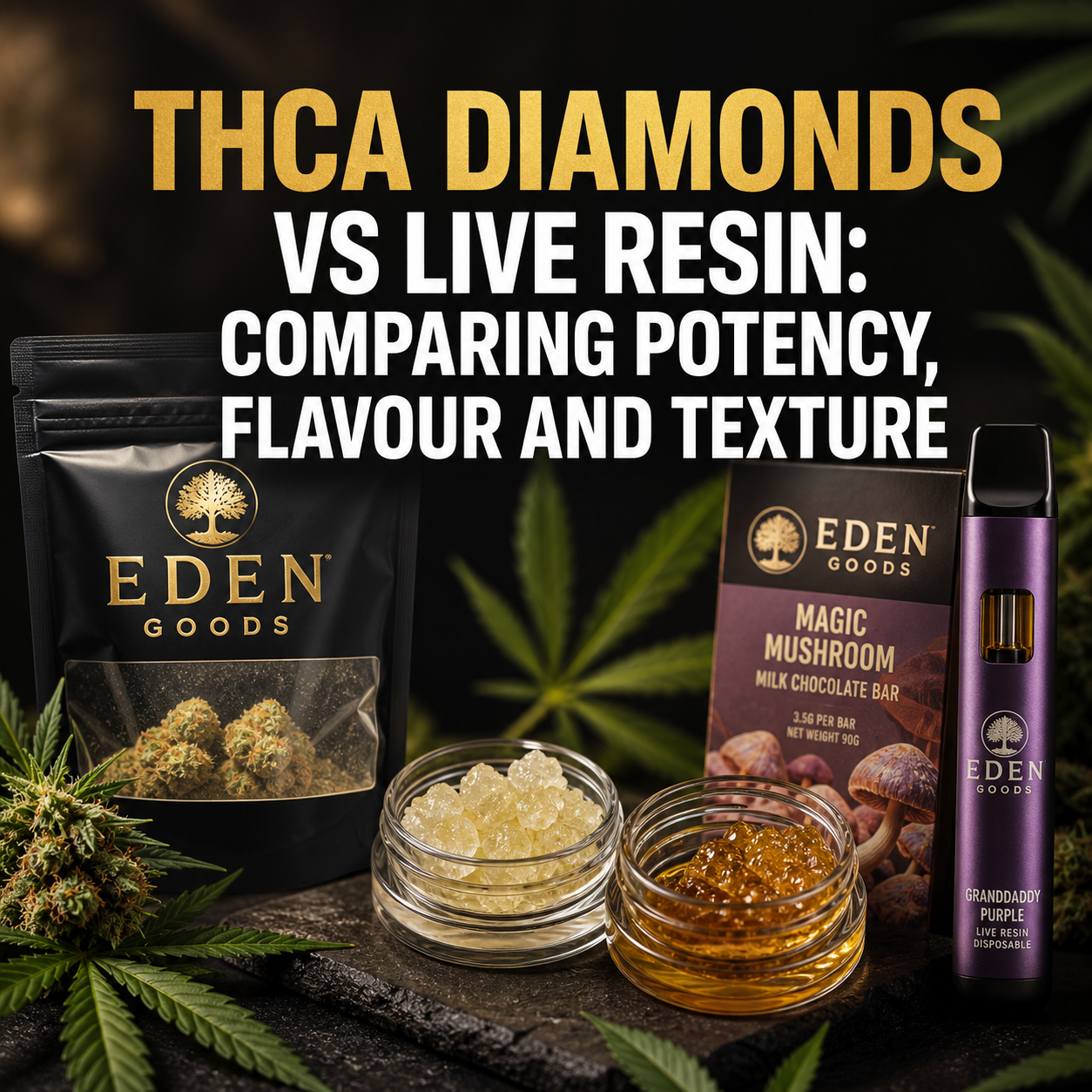
THCA Diamonds vs Live Resin: Comparing Potency, Flavour and Texture

THCA Diamonds vs Live Resin: Comparing Potency, Flavour and Texture
Choosing between THCA diamonds vs live resin usually comes down to three priorities: cannabinoid concentration, flavour and consistency. THCA diamonds are crystalline concentrates valued for their high proportion of tetrahydrocannabinolic acid. Live resin is a terpene-rich extract designed to preserve more of the fresh plant’s aromatic profile.
Neither option is automatically better. Diamonds often appeal to experienced consumers who want a concentrated, predictable cannabinoid profile. Live resin may suit those who place more importance on aroma, flavour and a broader mix of plant compounds. Product quality, laboratory results and individual tolerance matter more than appearance or marketing language alone.
This comparison explains how the two concentrates differ, what product labels can reveal and which safety points deserve attention. Cannabis laws vary by location, so always check local rules and purchase only from a regulated source where legal.
THCA Diamonds vs Live Resin at a Glance
| Feature | THCA diamonds | Live resin |
| Defining characteristic | Crystalline structures rich in THCA | Aromatic extract made from fresh or promptly frozen cannabis material |
| Main priority | Cannabinoid concentration | Flavour and terpene preservation |
| Typical texture | Solid crystals, often combined with a viscous sauce | Saucy, sticky, waxy or sugar-like |
| Aroma | Mild when highly refined; stronger when sold with terpene sauce | Usually pronounced and plant-specific |
| Potency | Often highly concentrated in THCA | Potent, but usually contains a broader balance of cannabinoids and terpenes |
| Consistency between products | Crystal composition may be relatively simple, but sauce changes the profile | Varies considerably by cultivar, process and storage |
| Best suited to | Experienced adults prioritising cannabinoid concentration | Adults prioritising aroma, flavour and a broader chemical profile |
These are general distinctions rather than fixed standards. A product called live resin can contain THCA crystals, while a jar of diamonds may include a terpene-rich liquid. The name on the package does not replace an independent laboratory report.
Explore related product education in [[LIEN_INTERNE: cannabis concentrates]].
What Are THCA Diamonds?
THCA diamonds are solid crystalline formations composed mainly of tetrahydrocannabinolic acid. THCA is a naturally occurring cannabinoid found in raw cannabis. In its unheated state, it does not produce the same intoxicating effect commonly associated with delta-9 THC.
Heat changes that distinction. During decarboxylation, THCA loses part of its molecular structure and becomes THC. Heated THCA diamonds can therefore produce strong intoxicating effects. The degree of conversion varies, which is why the THCA number on a label should not be read as though it were already an identical amount of active THC.
Why Do They Look Like Crystals?
Under controlled processing conditions, concentrated THCA molecules can separate from other components and form visible crystals. Their size ranges from small grains to larger faceted pieces. Colour may range from nearly clear to pale amber, depending on refinement and the presence of other compounds.
Appearance does not prove purity. Clear crystals can still require contaminant testing, and darker material is not necessarily unsafe or inferior. Only a batch-specific certificate of analysis can provide meaningful information about cannabinoid content and screened contaminants.
Diamonds and Sauce
Many products combine THCA crystals with “sauce,” a viscous fraction that may contain terpenes and additional cannabinoids. This improves aroma and makes the experience less one-dimensional than isolated crystals. It also means that two jars labelled THCA diamonds may differ significantly.
A jar containing mostly large crystals will not have the same texture or flavour as small diamonds immersed in terpene sauce. Check whether laboratory values apply to the complete product rather than to one component alone.
What Is Live Resin?
Live resin is a cannabis concentrate produced with plant material kept fresh, commonly through prompt freezing after harvest. Conventional dried flower loses or changes some volatile aromatic compounds during drying and curing. Live resin processing aims to retain more of the profile present in the fresh plant.
The word “live” does not mean the finished extract contains living material. It refers to the condition of the cannabis when preservation begins. Live resin is also distinct from live rosin. Although the names sound similar, resin and rosin belong to different processing categories.
Terpenes and Aroma
Terpenes are volatile aromatic compounds found in cannabis and many other plants. They contribute citrus, pine, floral, herbal, earthy and fuel-like notes. A well-preserved live resin often has a stronger and more recognisable aroma than highly refined THCA crystals.
Terpene content is not a simple quality score. More is not always better. A balanced profile may be more pleasant than an extremely intense one, and inhaled terpenes can irritate some people. Individual preference, sensitivity and product freshness all influence the experience.
Live Resin Textures
Live resin is a product family rather than one fixed consistency. It may be sold as:
- Sauce: a fluid or syrup-like concentrate with a pronounced aroma.
- Badder or batter: a whipped, creamy consistency.
- Sugar: small crystals suspended in a moist concentrate.
- Wax: a softer, less fluid material.
These terms are not applied uniformly across every market. Storage temperature, age and handling may also alter consistency. Texture alone cannot confirm how a concentrate was produced.
THCA Diamonds vs Live Resin: Which Is More Potent?
THCA diamonds generally have the advantage when potency means the highest concentration of a single cannabinoid. Their crystalline portion can be highly concentrated in THCA. Once heated, this can translate into an intense THC exposure.
Live resin can also be very potent. However, it usually retains a more varied mixture of cannabinoids, terpenes and other plant constituents. Its total cannabinoid concentration may therefore be lower than that of highly refined diamonds, even though its effects can still feel strong.
Why Label Percentages Need Context
Compare batch reports rather than relying on the product category. The most useful label information includes:
- THCA and delta-9 THC values;
- total THC, when clearly defined by the laboratory or regulator;
- other measured cannabinoids;
- terpene content, if tested;
- serving or package information where required;
- the batch number and testing date;
- screening results for relevant contaminants.
Laboratory figures also have limits. Sampling methods, allowable measurement variation and reporting rules differ between jurisdictions. A small numerical difference between two products may not create a noticeable real-world difference.
Potency Is Not the Same as Quality
A higher percentage does not guarantee a cleaner, safer or more enjoyable product. It also does not establish medical value. Very concentrated cannabis may increase the risk of anxiety, panic, confusion, dizziness, impaired coordination or other unwanted effects, particularly in someone with limited tolerance.
People using cannabis for a health-related reason should discuss it with a qualified healthcare professional. This is especially important when symptoms are new, persistent or worsening, or when other medicines are involved.
Which Has Better Flavour?
Live resin usually offers the more expressive flavour profile. Its central purpose is to preserve volatile compounds associated with fresh cannabis. The result may reflect the cultivar more clearly than isolated THCA crystals.
Pure diamonds are comparatively neutral because refinement removes much of the aromatic material. Diamonds sold in sauce are different. The liquid fraction can restore a strong terpene profile, narrowing the flavour gap between the categories.
Flavour quality remains subjective. Some consumers prefer the vivid, layered character of live resin. Others find terpene-rich concentrates overpowering and favour the cleaner profile of diamonds. Packaging and storage also matter because light, heat, oxygen and repeated opening may degrade aromatic compounds over time.
How Their Textures Affect Handling
Texture influences convenience as well as appearance. Solid diamonds can be difficult to divide evenly, particularly when crystal sizes vary. A sauce-heavy diamond product may separate in the container, leaving crystals and liquid distributed unevenly.
Live resin is often easier to portion when it has a uniform badder or sugar consistency. Very fluid sauce can be sticky and harder to manage. Cold storage may thicken some products, while warmth can make them more fluid and accelerate aromatic loss.
Follow the storage directions supplied by the licensed producer. Keep the container sealed, upright when appropriate and protected from light and heat. Always store cannabis in child-resistant packaging, locked away from children, teenagers and pets.
THCA Diamonds vs Live Resin: How to Choose
The right choice depends on your priorities, tolerance and access to regulated products. Avoid selecting a concentrate solely because it has the largest number on the label.
THCA Diamonds May Be More Suitable If You Prioritise
- a high concentration of THCA;
- a crystalline format;
- a relatively neutral profile when no sauce is present;
- clear cannabinoid information supported by batch testing.
Live Resin May Be More Suitable If You Prioritise
- a pronounced aroma and flavour;
- a profile associated with fresh plant material;
- a softer, saucier or sugar-like texture;
- a broader combination of cannabinoids and aromatic compounds.
New or infrequent cannabis consumers should be cautious with both categories. Concentrates can deliver substantially more cannabinoids in a small amount than cannabis flower. A product that is easy for one adult to tolerate may feel overwhelming to another.
How to Assess Product Quality
Marketing terms such as “premium,” “ultra-pure” and “top shelf” have little value without verifiable information. A trustworthy product should have traceable packaging and a batch-specific laboratory report, often called a certificate of analysis.
Check the Certificate of Analysis
Confirm that the batch number on the report matches the container. Depending on local requirements, testing may cover cannabinoid potency, residual processing solvents, pesticides, heavy metals and microbial contaminants. Not every jurisdiction requires the same panel, so learn what regulated testing includes in your area.
A report should identify the laboratory and testing date. Avoid products with missing, unreadable or unrelated documents. A QR code is useful only when it leads to a genuine report for the correct batch.
Inspect the Packaging
Packaging should be sealed, intact and clearly labelled. Look for ingredient information, required warnings, storage guidance and the producer’s details. Do not use a concentrate that shows unexpected debris, damaged packaging, leakage or an unusual odour that suggests contamination.
Do Not Rely on Colour Alone
Consumers often associate pale concentrates with purity, but colour depends on several factors. Plant material, age, processing choices and storage can all influence appearance. Very dark material may indicate degradation in some cases, yet visual inspection cannot replace laboratory screening.
Safety and Health Considerations
Both THCA diamonds and live resin are highly concentrated cannabis products. When heated, their cannabinoids may impair attention, judgement, reaction time and coordination. Do not drive, cycle on public roads, operate machinery or perform safety-sensitive tasks after use.
Avoid combining cannabis with alcohol or other intoxicating substances. Mixing substances may increase impairment and make effects less predictable. Keep all concentrates away from anyone for whom they were not intended.
Who Should Seek Professional Advice?
It is recommended to speak with a doctor or pharmacist before using cannabis if you take prescription medicines or have a history of heart problems, severe anxiety, psychosis or substance-use difficulties. Professional guidance is also important during pregnancy or breastfeeding. In these situations, avoiding cannabis may be advised.
Seek urgent medical help after severe chest pain, loss of consciousness, difficulty breathing, extreme confusion or any other alarming reaction. If a child or pet is exposed, contact the appropriate poison service, emergency provider or veterinarian immediately.
Medical Claims Require Caution
Neither “high THCA” nor “full spectrum” proves that a product can treat a condition. Effects vary, and product labels do not replace a diagnosis or an individual care plan. If you are considering cannabis for pain, sleep, nausea or another symptom, talk to a healthcare professional who understands your medical history.
Common Confusions to Avoid
THCA Is Not the Same as Delta-9 THC
THCA is the acidic precursor to THC. It is not typically intoxicating in the same way before heating, but it can convert to THC when exposed to heat. Legal definitions may account for this potential conversion, so a product marketed as THCA is not necessarily legal everywhere.
Live Resin Is Not Live Rosin
Live resin generally refers to an extract from fresh or frozen plant material made through a solvent-based professional process. Live rosin is produced through mechanical separation using heat and pressure after suitable preparation. The similar names do not describe the same category.
Diamonds Can Be Part of a Live Resin Product
The categories can overlap. THCA crystals may develop or be included in a terpene-rich live resin sauce. Such a product combines the concentrated crystalline element of diamonds with the aromatic qualities associated with live resin.
“Full Spectrum” Has No Single Universal Definition
The phrase generally suggests that multiple plant compounds remain in an extract. However, standards and labelling rules vary. Read the actual cannabinoid and terpene data rather than assuming that the term guarantees a particular composition or effect.
Frequently Asked Questions
Are THCA diamonds stronger than live resin?
They are often more concentrated in THCA, but the exact comparison depends on batch testing. Live resin can still be highly potent and may feel intense because of its broader chemical profile.
Does THCA cause a high?
Unheated THCA does not generally cause the same intoxication as THC. Heating converts THCA into THC, which can produce intoxicating and impairing effects.
Why does live resin taste stronger?
Live resin aims to preserve volatile aromatic compounds from fresh plant material. Its terpene-rich profile often produces a stronger flavour than highly refined THCA crystals.
Are diamonds with sauce the same as live resin?
Not necessarily. Sauce may be terpene-rich, but the starting material and processing category determine whether a producer identifies it as live resin. Check the label and batch report.
Which concentrate is better for beginners?
Neither is ideal for an inexperienced consumer because both can be very potent. Anyone choosing cannabis should understand the label, consider personal tolerance and follow local public-health guidance.
How should cannabis concentrates be stored?
Follow the producer’s directions. Keep them sealed, protected from heat and light, and locked in child-resistant packaging away from children and pets.
Can colour reveal whether a concentrate is safe?
No. Colour alone cannot confirm potency, purity or freedom from contaminants. Use regulated products with batch-specific laboratory results.
Conclusion: Potency or a Fuller Flavour Profile?
In the comparison of THCA diamonds vs live resin, diamonds generally lead on THCA concentration, while live resin usually stands out for flavour, aroma and textural variety. Diamonds with sauce can offer elements of both, which is why product names alone rarely tell the whole story.
Choose according to verified composition rather than visual appeal or exaggerated potency claims. Review the certificate of analysis, confirm the batch, inspect the packaging and account for your experience and health circumstances. If cannabis use relates to a medical concern, seek advice from a qualified healthcare professional.
Discover the product information available from Eden Goods and explore relevant Sphère Santé products according to your personal care needs. Always choose lawful, clearly labelled products from reputable sellers.