

Blog
Live Resin vs Cured Resin: Starting Material, Flavour and Texture Compared

Live Resin vs Cured Resin: Starting Material, Flavour and Texture Compared
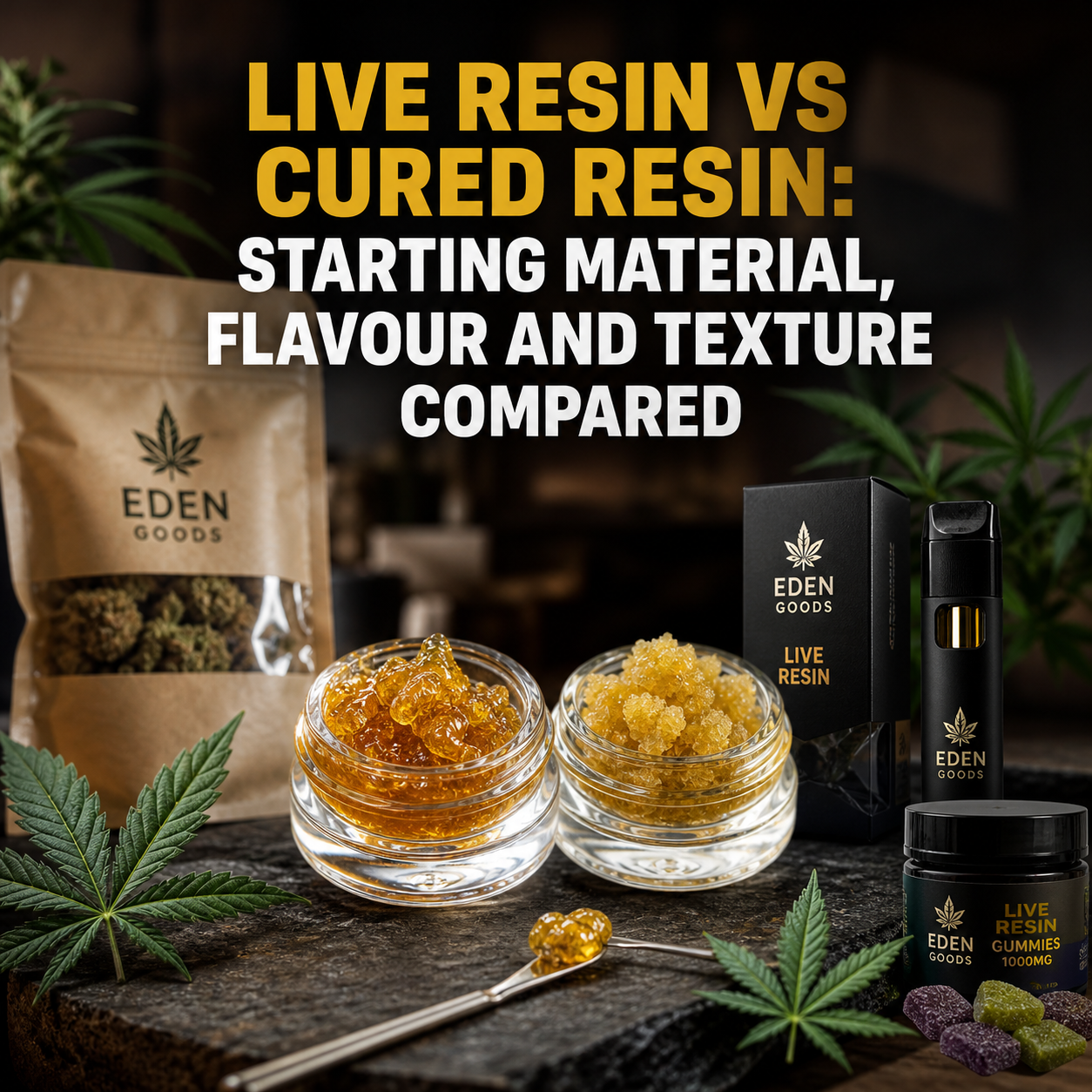
The main difference between live resin vs cured resin begins before extraction. Live resin uses cannabis that is frozen shortly after harvest. Cured resin uses flower that has already been dried and cured. This choice affects the aroma, flavour and possible consistency of the finished concentrate.
Live resin is often selected for its fresh, strain-specific terpene profile. Cured resin may offer a deeper, more mature flavour and is frequently more affordable. Neither category is automatically stronger or better. Extraction skill, storage, laboratory results and the quality of the original plant matter all influence the final product.
This guide explains how the two concentrates compare, what their names actually mean and which details deserve attention when assessing quality. Cannabis laws vary by location. Only purchase and use concentrates where doing so is legal, and keep all cannabis products away from children and pets.
Live Resin vs Cured Resin at a Glance
| Feature | Live resin | Cured resin |
| Starting material | Fresh cannabis frozen soon after harvest | Cannabis flower that has been dried and cured |
| Typical aroma | Fresh, vivid and strongly associated with the original cultivar | More mature, rounded or earthy, depending on the material |
| Terpene preservation | Designed to retain volatile aromatic compounds | Some volatile compounds may change or decline during drying and curing |
| Common textures | Sauce, badder, sugar or other soft consistencies | Badder, wax, crumble, shatter or sugar |
| Potency | Often high, but varies by batch | Often high, but varies by batch |
| Typical price | Often higher because frozen handling requires specialised equipment | Often lower, although premium cured resin can still be expensive |
| Main appeal | Fresh aroma and terpene expression | Value, stability and mature flavour |
These are tendencies rather than fixed rules. A carefully made cured resin can be more aromatic than a poorly handled live resin. The label describes the condition of the starting material, not a guaranteed level of quality.
The Starting Material Makes the Core Difference
How live resin begins
For live resin, producers harvest mature cannabis and freeze it promptly instead of drying it. The frozen material remains cold during storage and preparation. This process aims to limit the loss of volatile terpenes that can occur after harvest.
Terpenes contribute to the plant’s scent and flavour. Some evaporate or transform easily when exposed to heat, oxygen and time. Freezing does not preserve every compound perfectly, but it can retain a profile that more closely resembles the aroma of the living plant.
Live resin usually requires a controlled cold chain. Equipment, storage and processing conditions matter because thawing can damage the material and introduce unwanted moisture. Most commercial live resin is produced through hydrocarbon extraction in licensed facilities, followed by careful solvent removal and testing.
How cured resin begins
Cured resin starts with harvested cannabis that has undergone drying and curing. Drying removes much of the plant’s moisture. Curing then allows the flower to stabilise over time under controlled conditions.
This stage changes the chemical and aromatic character of the plant. Some of the brightest volatile notes may diminish, while other aromas can become smoother or more developed. A good cure can create complex results. Poor drying, excess heat or prolonged exposure to air can leave the material flat or harsh.
Once cured, the flower is extracted to separate cannabinoids and aromatic compounds from the plant matter. The resulting concentrate is called cured resin. It should not be confused with ordinary dried flower, despite sharing the same initial curing process.
Live Resin vs Cured Resin for Flavour and Aroma
Flavour is one of the strongest reasons consumers compare live resin and cured resin. Live resin commonly offers bright, fresh or pronounced notes. Depending on the cultivar, these may seem citrusy, floral, herbal, fruity, spicy or fuel-like.
Cured resin often has a warmer and more mature character. Earthy, woody, sweet or hash-like notes may become more noticeable. However, cultivar genetics still matter. Processing cannot create a terpene profile that was absent from the original plant.
Several factors influence the final sensory experience:
- Genetics: each cultivar produces a different combination of aromatic compounds.
- Harvest timing: plant maturity can affect cannabinoid and terpene composition.
- Temperature: excessive heat during processing or use can degrade delicate compounds.
- Oxygen and light: prolonged exposure may reduce freshness and alter flavour.
- Storage time: even a well-made concentrate changes as it ages.
- Extraction quality: good equipment does not compensate for poor technique or contaminated material.
Live resin is therefore not automatically the more flavourful choice. It is better understood as a style intended to capture fresh-frozen plant characteristics. A high-quality cured resin can deliver excellent flavour, especially when made from properly handled flower.
Texture and Consistency Compared
The terms live and cured do not define one specific texture. Either type can appear in several consistencies. Texture depends on cannabinoid composition, terpene content, processing temperature, agitation and post-extraction handling.
Common live resin textures
- Sauce: a fluid, terpene-rich portion that may contain cannabinoid crystals.
- Badder or batter: a soft, whipped consistency that is relatively easy to portion.
- Sugar: small cannabinoid crystals suspended in a moist, aromatic concentrate.
- Diamonds and sauce: larger crystalline structures combined with a liquid fraction.
Common cured resin textures
- Wax: an opaque, soft or slightly crumbly concentrate.
- Crumble: a drier consistency that breaks apart easily.
- Shatter: a firm, glass-like sheet created through specific processing conditions.
- Badder or sugar: textures that may look very similar to their live resin equivalents.
Appearance alone cannot reliably identify the starting material. A soft concentrate is not necessarily live resin, and a firm product is not necessarily cured resin. Product information and batch documentation provide a better basis for comparison.
Separation is not always evidence of spoilage. Terpene-rich liquid can naturally move away from crystals over time. However, an unusual smell, visible foreign material, damaged packaging or missing batch information should raise concern. Do not use a product if its safety or origin is uncertain.
Is Live Resin Stronger Than Cured Resin?
Live resin is not inherently stronger than cured resin. Both can contain high concentrations of THC or other cannabinoids. The exact potency depends on the source plant, extraction process and composition of the finished batch.
Two products with similar THC values can also feel different. Terpenes, minor cannabinoids, individual tolerance, serving size and method of use may all influence the experience. A higher laboratory percentage does not guarantee greater enjoyment or better quality.
Concentrates can deliver substantially more THC in a small amount than cannabis flower. Effects may include impaired attention, slowed reaction time, anxiety, dizziness or an uncomfortable level of intoxication. New or sensitive consumers should take particular care with portion size and allow time to assess effects before considering more.
Do not drive, cycle, operate machinery or perform safety-critical tasks while impaired. Avoid combining cannabis with alcohol or other intoxicants. Anyone who is pregnant, breastfeeding, taking medication or managing a physical or mental health condition should discuss cannabis use with a qualified healthcare professional.
How the Experience May Differ
People often describe live resin as vivid, aromatic and close to the scent of fresh cannabis. Cured resin may feel more traditional because its flavour resembles well-cured flower or hash. These descriptions concern sensory qualities, not predictable medical or psychological outcomes.
No product name can guarantee how a person will respond. Individual reactions depend on tolerance, previous experience, product composition and setting. Even batches sold under the same cultivar name can differ.
When comparing options, consider your priorities:
- Choose based on verified composition rather than marketing claims.
- Look for a terpene-rich profile if aroma and flavour matter most.
- Consider cured resin when value or a more mature flavour is the priority.
- Select a texture compatible with the equipment you legally use.
- Avoid treating THC percentage as the only sign of quality.
Consumers using cannabis for symptom management should not rely on labels such as live or cured to predict therapeutic effects. Speak with a doctor or pharmacist familiar with your health history, especially if symptoms are persistent or medication interactions are possible.
Live Resin, Cured Resin and Rosin Are Not the Same
Resin and rosin are easy to confuse, but they describe different product categories. Commercial resin concentrates are commonly produced with a solvent-based extraction process. Rosin is made by applying heat and pressure to cannabis material or hash, without hydrocarbon solvents.
Live rosin usually begins with fresh-frozen material. Producers commonly wash that material to make hash before pressing it. Cured rosin begins with dried or cured material. These products may share flavour or texture characteristics with resin, but their production methods differ.
The word resin can also refer to the natural sticky trichomes found on cannabis plants. It should never be confused with the dark residue collected from a used pipe. That residue contains combustion by-products and is not equivalent to a professionally produced concentrate.
How to Assess Quality Before Buying
A reliable label should provide more than a product name and THC claim. Requirements vary by jurisdiction, but transparent producers generally make batch-specific information available.
Check the source and testing information
- A clear producer or processor name
- A batch or lot number
- A production or packaging date
- Cannabinoid results from an appropriate laboratory
- Contaminant screening required by local regulations
- Ingredients, including any added cannabis-derived terpenes
- Storage guidance and legally required warnings
Laboratory testing may include checks for residual solvents, pesticides, microbes, heavy metals or other contaminants, depending on local rules. A certificate does not make cannabis risk-free, but traceable testing offers more useful assurance than colour, smell or branding alone.
Be cautious with vague marketing language
Terms such as premium, full spectrum and craft do not have one universal definition. Ask what they mean for the specific product. Likewise, a claim of live resin should indicate that the concentrate was extracted from fresh-frozen cannabis, not merely flavoured to imitate one.
Some vape products use live resin, while others combine a refined cannabinoid distillate with added terpenes and market the flavour as live-style. Read the ingredient list carefully. A true live resin formulation and a distillate-based formulation are not identical.
Do not judge quality by colour alone
Concentrates range from pale gold to amber or darker brown. Colour can reflect cultivar, plant maturity, extraction method, oxidation and filtration. Very pale resin is not automatically purer, and dark resin is not automatically unsafe. Traceability, aroma, handling and laboratory information provide better evidence.
Storage and Freshness
Heat, light, air and moisture can change both live resin and cured resin. Terpenes may evaporate, cannabinoids may degrade and textures may become drier or less uniform.
Keep the product tightly sealed in its original child-resistant container. Store it upright in a cool, dark location, following the instructions on the label. Some concentrates benefit from refrigeration, but repeated temperature changes can create condensation. If refrigerated, allow the sealed container to approach room temperature before opening it.
Always keep cannabis locked away from children, teenagers and pets. The concentrated format may be difficult to recognise, and even a small amount can cause serious adverse effects in a child or animal. Contact local emergency or poison-control services if accidental exposure occurs.
Common Myths About Live Resin vs Cured Resin
Live resin is always more potent
This is false. Live resin may retain more volatile aromatic compounds, but terpene preservation does not equal higher THC. Potency must be assessed through batch-specific laboratory results.
Cured resin uses inferior cannabis
Not necessarily. It can be made from carefully cultivated, properly cured flower. As with any concentrate, quality ranges from poor to exceptional.
Live resin is solventless
This is usually incorrect. Most commercial live resin is extracted with solvents in controlled facilities. Live rosin is the better-known solventless category made from fresh-frozen material.
Texture proves whether a concentrate is live or cured
It does not. Both categories can become sauce, sugar or badder. Processing and composition determine consistency.
More terpenes always means a better product
Not for every consumer. A balanced profile, safe production and an enjoyable aroma matter more than one large number. High terpene content may also feel irritating when inhaled at excessive temperatures.
Frequently Asked Questions
What is the biggest difference between live resin and cured resin?
Live resin begins with fresh-frozen cannabis. Cured resin begins with cannabis that has been dried and cured. This distinction mainly affects aromatic preservation and flavour.
Does live resin taste better than cured resin?
It often tastes fresher or more vivid, but better is subjective. Well-made cured resin can offer complex, mature flavour and may suit people who prefer traditional cannabis notes.
Which concentrate has more terpenes?
Live resin often retains more volatile terpenes, but the result varies by cultivar, extraction and storage. Check batch-specific information rather than relying only on the category name.
Is cured resin the same as distillate?
No. Cured resin retains a broader mixture of compounds extracted from cured cannabis. Distillate is a highly refined cannabinoid product and may contain terpenes added after distillation.
Can live resin and cured resin have the same texture?
Yes. Either may be sold as badder, sugar or sauce. Texture does not reliably reveal whether the starting material was fresh-frozen or cured.
Which option is better for a beginner?
Neither is automatically beginner-friendly because both may be highly potent. Review tested potency, use the smallest practical amount and follow local guidance. Seek professional advice if health concerns apply.
How long do resin concentrates stay fresh?
There is no single lifespan for every product. Packaging, temperature, air exposure and formulation all matter. Follow the labelled storage instructions and use-by guidance.
Conclusion
In the live resin vs cured resin comparison, starting material is the defining difference. Live resin uses fresh-frozen cannabis to preserve a vivid aromatic profile. Cured resin uses dried and cured flower, often delivering mature flavour, varied textures and good value.
Neither name guarantees potency, purity or quality. Choose products with clear ingredients, batch details, appropriate testing and secure packaging. Consider flavour and texture, but place legal sourcing and responsible use first. If cannabis could affect a medical condition or interact with medication, consult a qualified healthcare professional.
