


Blog
Cannabis Capsules vs Edibles: Differences in Onset, Duration and Convenience

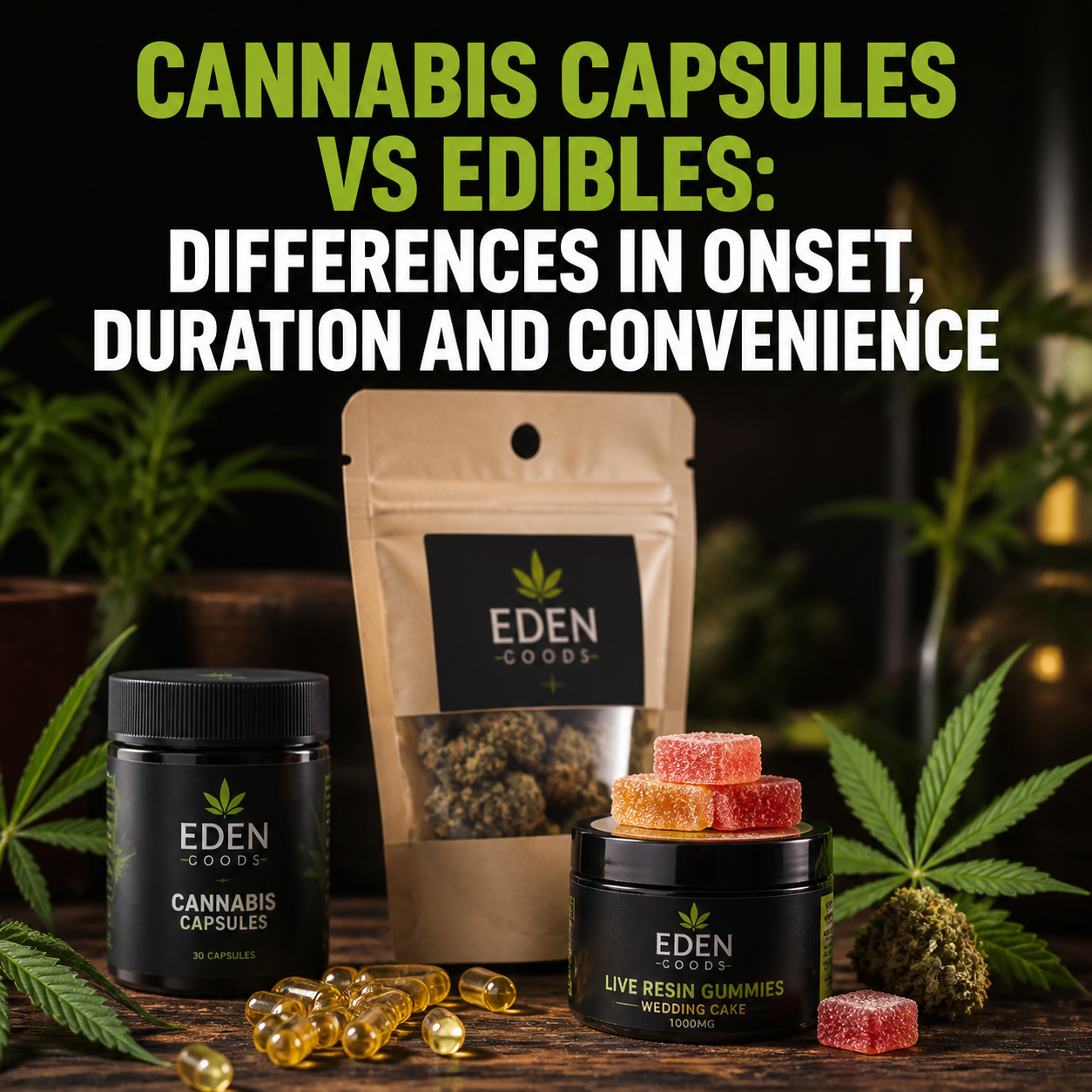
Cannabis Capsules vs Edibles: Differences in Onset, Duration and Convenience
Choosing between cannabis capsules vs edibles can be confusing. Both are swallowed, both avoid smoke, and both may produce effects that last longer than inhaled cannabis. However, they differ in taste, convenience, formulation, dose flexibility and the experience surrounding each serving.
The short answer is that capsules usually offer a discreet, measured and flavor-free format. Edibles provide more variety and can feel more familiar because they resemble ordinary foods or drinks. Neither option is automatically stronger, faster or better. The cannabinoid content, formulation, serving size, personal metabolism and recent meals matter more than the format alone.
This guide explains how oral cannabis products work, what affects their onset and duration, and how to compare them responsibly. Cannabis laws vary by location. Always follow local regulations and consult a qualified healthcare professional before using cannabis for a health-related purpose.
Cannabis Capsules vs Edibles at a Glance
| Comparison point | Cannabis capsules | Cannabis edibles |
| Format | Softgels, hard capsules or tablets | Gummies, chocolates, baked goods, mints, beverages and other foods |
| Route | Swallowed and processed through digestion | Eaten or drunk and usually processed through digestion |
| Typical onset | Often delayed and variable | Often delayed and variable; beverages and fast-acting formulas may differ |
| Duration | Often several hours | Often several hours |
| Taste | Little or no cannabis flavor | Varies by recipe and flavoring |
| Serving consistency | Usually pre-measured per capsule | Often pre-measured, but splitting a serving may reduce precision |
| Discretion | High; resembles a supplement | Depends on the product and packaging |
| Dose flexibility | Limited unless several capsule strengths are available | Potentially broader, although portions must remain accurately labeled |
| Dietary considerations | Check carrier oils and capsule material | Check sugar, allergens, gelatin and other ingredients |
These are general differences rather than guarantees. A carefully formulated edible may be as consistent as a capsule. Likewise, two capsules can feel different if they contain different cannabinoids, extracts or delivery technologies.
What Are Cannabis Capsules?
Cannabis capsules contain a measured amount of cannabis extract inside a softgel, hard shell or tablet-like format. The extract may include THC, CBD, a combination of cannabinoids, or a broader range of plant compounds. Product labels should identify the amount per capsule and per package.
Many softgels combine cannabinoids with a carrier oil. Cannabinoids dissolve in fat, so oils are commonly used in oral formulations. The shell may contain gelatin or a plant-based alternative. Anyone following a vegan diet or avoiding specific ingredients should review the complete ingredient list.
Main advantages of cannabis capsules
- Simple servings: Each capsule generally contains a predetermined quantity.
- No cannabis taste: The shell masks most flavors and aromas.
- Discreet format: Capsules are compact and easy to store in their original container.
- No preparation: There is no need to cut, measure or cook anything.
- Ingredient simplicity: Some formulas contain fewer ingredients than sweets or baked goods.
Capsules also have limitations. They can be difficult for people who do not swallow pills comfortably. Their fixed strength may offer less flexibility, and their effects can still take time to appear. Taking another capsule too soon can lead to an unexpectedly intense or prolonged experience.
What Are Cannabis Edibles?
Cannabis edibles are foods or drinks infused with cannabinoids. Gummies and chocolates are common, but the category also includes mints, baked products and beverages. Explore related formats through [[LIEN_INTERNE: Cannabis Edibles]].
Edibles can contain THC, CBD or both. THC can cause intoxication and impair judgment, coordination and reaction time. CBD does not produce the same intoxicating effect, but it can still cause side effects and interact with medications. A product’s appearance or flavor does not indicate its potency.
Main advantages of edibles
- Wide selection: Consumers can choose among textures, flavors and dietary formats.
- Familiar experience: Eating a gummy or chocolate may feel more approachable than swallowing a capsule.
- Different cannabinoid profiles: Products may offer THC, CBD or balanced formulations.
- Portion options: Some products provide several clearly defined serving sizes.
- Smoke-free use: No combustion or inhalation is involved.
The familiar appearance of edibles creates an important safety concern. Gummies and chocolates can look like ordinary candy. They should always remain in child-resistant original packaging, locked away from children, teenagers, pets and other adults who may consume them accidentally.
Do Cannabis Capsules and Edibles Have the Same Onset?
Standard capsules and traditional edibles usually have a delayed onset because they travel through the digestive system before cannabinoids reach the bloodstream. Effects may begin within roughly 30 minutes to two hours, but this range is not a promise. For some people or products, the delay may be longer.
Several factors influence onset:
- Whether the product is taken with food
- The size and composition of the recent meal
- Individual digestion and metabolism
- The cannabinoid type and quantity
- The extract and carrier ingredients
- Previous cannabis exposure and tolerance
- The use of standard or fast-acting delivery technology
Some beverages, dissolvable products and specially formulated edibles are marketed as fast acting. Their formulation may allow an earlier onset than a conventional gummy or baked product. However, the label and manufacturer information should guide expectations. The word “edible” alone does not reveal how quickly a product will act.
Why oral THC can feel different
After THC is swallowed, it passes through the digestive tract and liver. The body converts part of it into metabolites, including 11-hydroxy-THC. This process can contribute to effects that feel different from inhaled cannabis and may last longer.
This does not mean every oral THC product will feel stronger. Individual response varies considerably. A person’s experience on one day may also differ on another day because of meals, sleep, medications or other factors.
Cannabis Capsules vs Edibles: How Long Do Effects Last?
Both cannabis capsules and edibles can produce effects lasting several hours. For many oral products, effects may continue for approximately four to eight hours, sometimes longer. Residual drowsiness or impairment may persist after the most noticeable effects have faded.
Duration depends on the amount of THC or other cannabinoids, formulation, metabolism, tolerance and whether additional servings were consumed. Higher quantities do not simply increase intensity. They may also extend the experience and raise the risk of unwanted effects.
Do not assume that you are safe to drive because several hours have passed. Never drive, cycle on public roads, use machinery or perform hazardous tasks while impaired. If you still feel drowsy, slowed, dizzy or mentally altered, wait and arrange another form of transportation.
Which Format Offers More Consistent Dosing?
Capsules often have an advantage in convenience because each unit is designed to contain a specific amount. There is no need to estimate the size of a bite or divide a softgel. This can make serving records easier to maintain.
Commercially produced edibles can also provide consistent servings when they come from a reputable, regulated source and display clear laboratory-tested cannabinoid content. A gummy labeled as one serving can be just as straightforward as a capsule.
Problems arise when an edible must be cut into small pieces, when cannabinoids are not distributed evenly, or when a homemade product lacks reliable testing. Dividing a gummy or baked good does not always guarantee that each piece contains an equal amount.
Read the label in two places
Check both the amount per serving and the total amount per package. A package may contain several servings even when it looks small. Confirm whether one capsule, one gummy or only part of an item represents the stated serving.
Also distinguish milligrams of THC from milligrams of total cannabis extract. These figures do not necessarily mean the same thing. If labeling is unclear, do not guess. Ask the retailer or manufacturer for clarification.
Convenience, Taste and Lifestyle Differences
The best format often depends on practical preferences rather than a major difference in effect. Consider how and where the product will be used, stored and transported within local laws.
Capsules may suit people who prefer
- A neutral, flavor-free option
- A compact and discreet format
- A fixed quantity in each unit
- Fewer sugars or sweeteners
- A routine that resembles taking a supplement
Edibles may suit people who prefer
- Flavors and textures rather than pills
- A broader range of product types
- Options that do not require swallowing a capsule
- Clearly separated individual servings
- A food-based experience
Discretion should never come at the expense of safety. Keep any product in its original labeled container. Moving capsules into a supplement bottle or edibles into an ordinary food container increases the chance of accidental use and makes emergency identification harder.
Ingredients and Dietary Needs
Cannabinoid content is only one part of the label. Edibles may contain sugar, artificial sweeteners, nuts, dairy, gluten, soy or gelatin. Capsules may include gelatin, coconut-derived oils, other carrier oils, colorings or additives.
People with food allergies should not rely only on the product name or front label. Review the allergen statement, ingredient list and manufacturing warnings. Cross-contact may matter for severe allergies.
If you have diabetes, digestive concerns, difficulty swallowing or a medically prescribed diet, discuss the format with a healthcare professional. A clinician or pharmacist can help evaluate ingredients and possible medication interactions without assuming that cannabis is appropriate for your condition.
THC, CBD and Cannabinoid Ratios Matter More Than Format
Comparing a THC capsule with a CBD gummy is not a like-for-like comparison. The main cannabinoids and their quantities shape the likely experience more than whether the product is a capsule or edible.
- THC: Intoxicating and capable of impairing coordination, judgment and attention.
- CBD: Not intoxicating in the same way as THC, but not risk-free.
- Balanced products: Contain both THC and CBD in a stated ratio.
- Other cannabinoids: May appear in smaller amounts, with effects that are less predictable or less extensively studied.
Terms such as “full spectrum,” “broad spectrum” and “isolate” describe aspects of formulation. They do not guarantee quality, safety or a particular result. Look for transparent cannabinoid quantities, batch information and independent testing where required or available.
How to Use Oral Cannabis More Responsibly
Oral cannabis can be easy to overconsume because the effects are delayed. Someone may take an additional serving before the first has fully developed. The combined effect can then become uncomfortable and last for hours.
- Choose a legal, clearly labeled product from a reputable source.
- Read the complete package before use.
- Use the lowest labeled serving appropriate to your experience and local guidance.
- Allow enough time for delayed effects before considering more.
- Avoid combining cannabis with alcohol or other intoxicating substances.
- Do not drive or operate machinery after use.
- Store the product locked, out of sight and in its original packaging.
People can respond very differently to THC. Older adults, new consumers and people taking several medications may be more vulnerable to dizziness, confusion, sedation or falls. Individual medical advice is especially important in these situations.
When to speak with a healthcare professional
Talk with a doctor or pharmacist before using cannabis if you take prescription medication, have a heart condition, experience significant anxiety, have a history of psychosis, or live with liver or kidney disease. Professional advice is also recommended before using cannabis for pain, sleep or another symptom.
Cannabis should generally be avoided during pregnancy and breastfeeding. It must not replace prescribed treatment without guidance from the clinician managing your care.
Seek urgent help if someone develops severe confusion, chest pain, difficulty breathing, loss of consciousness, a seizure or another alarming symptom. Contact a poison control service or emergency service after accidental ingestion, particularly when a child or pet is involved.
How to Choose Between Cannabis Capsules and Edibles
Start with the product information rather than the format. Compare cannabinoid content, serving size, ingredients, testing, storage instructions and expected onset. Then consider your personal priorities.
| If your priority is… | Consider… |
| No flavor or sweetness | A capsule with a simple ingredient list |
| Avoiding pills | A clearly portioned edible or beverage |
| Fixed individual servings | Pre-measured capsules or single-serving edibles |
| Dietary compatibility | The option with verified ingredients and allergen information |
| Faster onset | A specifically labeled fast-acting formula, not simply any edible |
| Discretion | Capsules, while retaining the original labeled packaging |
No table can predict an individual’s response. If you have had an unpleasant reaction to cannabis before, do not assume that switching from an edible to a capsule will prevent it. The THC quantity and your personal sensitivity remain important.
Frequently Asked Questions
Are cannabis capsules considered edibles?
They are both oral cannabis products, although retailers often list capsules and food-based edibles as separate categories. Both usually pass through digestion before producing effects.
Do cannabis capsules work faster than gummies?
Not necessarily. Standard capsules and gummies can have similarly delayed onset times. Formulation, meals and metabolism often matter more than the physical format.
Are cannabis capsules stronger than edibles?
No format is inherently stronger. Compare the milligrams of THC, CBD and other cannabinoids per serving. Products with the same labeled quantity may still feel different.
Can cannabis capsules be opened or split?
Do not open, crush or split a capsule unless the manufacturer or a pharmacist confirms that it is appropriate. Altering it may affect serving accuracy or how the formula works.
How long should I wait before taking more?
Follow the product label and applicable local guidance. Oral effects may take two hours or longer to develop, so taking more too soon increases the risk of overconsumption.
Are CBD capsules and CBD edibles risk-free?
No. CBD may cause side effects and interact with medicines. Discuss it with a doctor or pharmacist if you use prescriptions or manage a health condition.
Which option is better for beginners?
Neither format is universally better. A clearly labeled, lower-THC product with a simple serving size may be easier to understand. Professional guidance may be appropriate for health-related use.
Conclusion: Cannabis Capsules vs Edibles
In the comparison of cannabis capsules vs edibles, the two formats share a delayed onset and potentially long duration. Capsules stand out for fixed servings, discretion and lack of flavor. Edibles offer more choice in taste, texture and presentation.
The product’s THC or CBD content, formulation, ingredients and serving size matter more than its category. Read labels carefully, allow for delayed effects, avoid driving, and store every product securely. If you take medication or want to use cannabis for a health concern, speak with a qualified healthcare professional first.
Discover the carefully selected Sphère Santé products available through Eden Goods and compare product labels, ingredients and formats before making an informed choice. Availability and eligibility depend on local law. [[LIEN_INTERNE: Cannabis Edibles]]