


Blog
Cannabis Cultivar vs Strain: Understanding the Difference on Product Labels

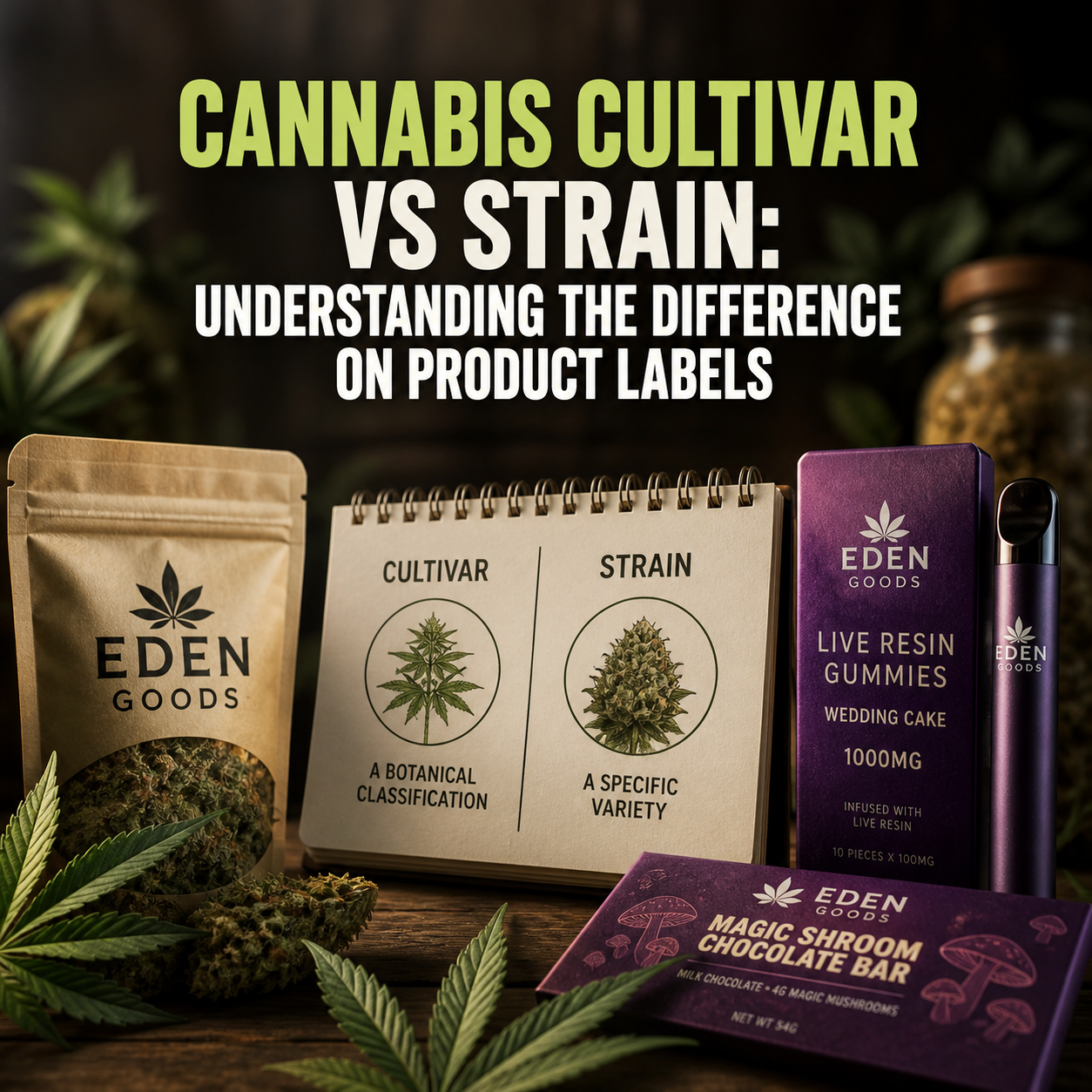
Cannabis Cultivar vs Strain: Understanding the Difference on Product Labels
The terms on a cannabis flower label can be confusing. One package may describe its contents as a strain. Another may use cultivar, variety, phenotype, or chemovar. These words often appear interchangeable, but they do not describe exactly the same thing.
In the cannabis cultivar vs strain discussion, cultivar is generally the more accurate horticultural term. Strain remains common in everyday cannabis language and retail settings. A chemovar, meanwhile, classifies cannabis by its chemical profile rather than by its name or claimed ancestry.
Understanding these distinctions can help you compare products more carefully. It can also prevent you from relying too heavily on a familiar name, an indica or sativa category, or marketing language that may not predict the contents of a specific package.
Cannabis Cultivar vs Strain: The Short Answer
A cultivar is a cultivated plant selection maintained for particular characteristics. These may include aroma, growth pattern, flower structure, cannabinoid content, or terpene expression. The word comes from the idea of a cultivated variety.
A strain is an informal term widely used by cannabis consumers, breeders, and retailers. In biology, strain more often refers to distinct lines of microorganisms, viruses, or laboratory organisms. For cultivated plants, cultivar is usually more precise.
However, seeing strain on a label does not automatically mean the information is wrong or misleading. It reflects established industry vocabulary. In many stores, strain name and cultivar name refer to the same marketed plant line.
| Term | What it usually describes | What it can tell you | Main limitation |
| Cultivar | A cultivated plant selection | Its intended identity, lineage, or selected traits | Plants and harvests can still vary |
| Strain | An informal commercial or cultural name | The general product family being marketed | Naming is not universally standardized |
| Chemovar | A chemically defined group | Cannabinoid and sometimes terpene characteristics | Requires current analytical data |
| Phenotype | Observable expression of a plant’s genetics | How one plant expresses traits under specific conditions | Environment influences expression |
Why Cultivar Is More Accurate Than Strain
Horticulture uses cultivar to identify plants selected and cultivated for recognizable characteristics. Growers may preserve a cannabis cultivar through cloning, controlled breeding, or carefully maintained seed lines. The aim is to reproduce a useful combination of traits.
Those traits may include:
- Cannabinoid composition
- Terpene profile and aroma
- Flower density and appearance
- Plant height and structure
- Flowering time
- Resistance or sensitivity to environmental stress
- Yield under particular growing conditions
The term does not guarantee that every package with the same cultivar name will be identical. Cannabis is a biologically variable plant. Genetics matter, but cultivation, harvest timing, drying, curing, storage, and testing methods also affect the finished flower.
Why the Word Strain Remains Common
Strain has decades of recognition in cannabis culture. Consumers use it to ask about names, lineages, aromas, and expected experiences. Retail menus and product databases also rely heavily on the term.
For that reason, it is unlikely to disappear from packaging or conversation. In practical retail use, cannabis strain often means a named plant type or product line. Cultivar communicates a similar idea with more precise plant terminology.
The most useful approach is not to reject either word. Instead, understand what each term can and cannot prove about the flower inside the package.
What Is a Cannabis Chemovar?
A chemovar, short for chemical variety, groups cannabis according to measurable chemical characteristics. This approach focuses on what the flower contains rather than what it is called.
Cannabinoids such as THC and CBD are central to chemovar classification. More detailed descriptions may also consider minor cannabinoids and dominant terpenes. In practice, the amount of chemical information available depends on local testing and labeling requirements.
Two products sold under different cultivar names may have similar cannabinoid profiles. Conversely, two packages with the same name may show meaningful differences in potency or terpene composition. This is why current batch information can be more useful than reputation alone.
Common Cannabinoid-Based Groupings
A simple classification system often divides cannabis into broad chemical types:
- THC-dominant: THC substantially exceeds CBD.
- Balanced THC and CBD: Both cannabinoids appear in meaningful proportions.
- CBD-dominant: CBD substantially exceeds THC.
These groupings provide more practical information than a cultivar name alone, but they still do not predict one exact experience. Dose, tolerance, consumption method, individual sensitivity, setting, and other substances can all influence how someone responds.
Why the Same Cannabis Cultivar Can Vary
A cultivar name suggests continuity, not perfect uniformity. Even when producers begin with closely related genetics, the finished flower can differ from one batch to another.
Genotype and Phenotype
A genotype is the plant’s genetic makeup. A phenotype is the observable expression produced by genetics interacting with the environment.
Seeds from the same cross can produce plants with different aromas, structures, colors, or chemical profiles. Growers may select one desirable phenotype and reproduce it through clones. Cloning preserves the genotype more closely than growing new seeds, but it does not eliminate environmental effects.
Growing Conditions
Light intensity, temperature, humidity, nutrition, irrigation, plant health, and harvest timing can influence development. Indoor, greenhouse, and outdoor production can therefore produce noticeable differences, even when the cultivar name is the same.
Drying, Curing, and Storage
Post-harvest handling also matters. Excess heat, light, air, or moisture can affect aroma, texture, and chemical stability. A well-known cultivar may seem different if it was dried rapidly, stored for a long period, or exposed to unsuitable conditions.
Batch-Specific Testing
Laboratory results represent a submitted sample. They are more informative when they relate directly to the batch or lot printed on the package. Results from another harvest, an undated promotional page, or a general cultivar profile may not describe the product currently in front of you.
Does the Cultivar Name Guarantee Genetics?
Not necessarily. Cannabis cultivar names do not always operate within one universal naming and registration system. Different breeders or producers may use the same name for genetically different plants. A cultivar may also be renamed for branding, regional preferences, or trademark considerations.
Lineage statements can offer helpful context, especially when a producer identifies the breeder and parent plants. Still, lineage alone does not verify the chemical composition of a finished batch.
A name should therefore act as a starting point. For a more complete comparison, combine it with:
- The producer or licensed brand
- The batch or lot number
- Current cannabinoid results
- Terpene information, when available
- Harvest and packaging dates
- Testing documentation required in your jurisdiction
Are Indica and Sativa the Same as Cultivars?
No. Indica and sativa are broad terms with botanical, historical, and commercial meanings. On modern retail labels, they often appear as shorthand for expected plant traits or consumer experiences. They are not substitutes for a cultivar name or a batch-specific chemical profile.
Many commercially available cannabis plants have complex hybrid ancestry. As a result, an indica, sativa, or hybrid label may not reliably explain cannabinoid content, terpene composition, or how a particular person will feel.
Descriptions such as relaxing, uplifting, creative, or energizing are also subjective. They may reflect common customer impressions or brand positioning, but they are not guarantees.
| Label detail | Useful for | Should not be treated as |
| Indica, sativa, or hybrid | A broad retail category | A precise prediction of effects |
| Cultivar or strain name | Identifying the marketed plant line | Proof of identical genetics or chemistry |
| Cannabinoid values | Comparing tested potency and ratios | A complete forecast of experience |
| Terpene results | Understanding aroma and chemical composition | A medical recommendation |
How to Read a Cannabis Flower Label
Label requirements vary by country, state, province, and product category. Use the rules that apply where you live. In a regulated market, several pieces of information can help you evaluate cannabis flower more carefully.
1. Product and Cultivar Name
Check both the cultivar name and the producer. The producer matters because cultivation and post-harvest methods can affect consistency. If you are comparing a repeat purchase, confirm that the package comes from the same producer rather than relying on the name alone.
2. THC, THCA, CBD, and CBDA
Raw flower often contains acidic cannabinoids such as THCA and CBDA. Heat converts part of these compounds into THC and CBD through decarboxylation.
Some labels list individual values. Others provide a total or potential THC figure. A common calculation adds delta-9 THC to THCA multiplied by approximately 0.877, accounting for molecular weight lost during conversion. Local regulations and laboratory reporting formats differ, so compare values presented on the same basis.
A higher THC number does not automatically mean better flower. Potency is only one characteristic, and individual sensitivity varies. People with limited experience should avoid assuming that a familiar cultivar name makes a high-potency product predictable.
3. Terpene Information
Terpenes are aromatic compounds found in cannabis and many other plants. Labels or certificates may list compounds such as myrcene, limonene, pinene, linalool, or caryophyllene.
Terpene data can help explain aroma and distinguish batches with similar cannabinoid values. However, a terpene name alone does not establish a guaranteed effect or medical benefit. Product freshness and storage also influence aroma.
4. Batch or Lot Number
The batch number connects the package to production and testing records. It is especially important when reviewing a certificate of analysis. The number on the certificate should match the package whenever batch-level documentation is available.
5. Harvest and Packaging Dates
Dates provide context about freshness. They do not tell the whole story because proper curing and storage matter, but they can help explain differences in moisture, texture, and aroma.
6. Testing and Regulatory Details
Depending on local rules, a label or accompanying record may include testing for cannabinoid potency and contaminants. It may also show a license number, laboratory name, testing date, or link to documentation.
When reviewing a certificate of analysis, confirm that it identifies the correct product and batch. Look for clear units, test dates, and final results rather than relying only on a promotional summary.
7. Infused or Added Ingredients
Not every product sold as flower contains only dried cannabis. Infused flower and pre-rolls may include concentrates, added terpenes, flavoring agents, or other ingredients. Read the full product description so you know whether the potency comes from the flower itself or from added cannabis extracts.
A Practical Cannabis Cultivar vs Strain Shopping Checklist
When comparing cannabis flower, use the name as one part of the decision rather than the entire decision.
- Identify the cultivar or strain name and the producer.
- Check whether the product is THC-dominant, balanced, or CBD-dominant.
- Compare THC values using the same reporting format.
- Review terpene results if current batch data is available.
- Match the batch number to any laboratory documentation.
- Check harvest, testing, and packaging dates.
- Confirm whether the flower is infused or contains added ingredients.
- Read mandatory warnings and follow local possession and use laws.
- Store the product securely away from children and pets.
If consistency matters to you, keep a simple record of the producer, batch, cannabinoid values, terpene profile, amount used, and your personal response. Do not rely on memory or the cultivar name alone.
Health and Safety Considerations
Product terminology does not make cannabis risk-free. THC can impair attention, coordination, judgment, and reaction time. Do not drive or operate machinery while impaired. Avoid combining cannabis with alcohol or other intoxicating substances.
Individual responses can differ, particularly with high-THC products. If cannabis is legal where you live and you choose to use it, follow the product directions and local public health guidance. Store it in its original packaging and keep it inaccessible to children and animals.
Speak with a qualified healthcare professional before using cannabis if you are pregnant or breastfeeding, take prescription medication, have a history of problematic substance use, or live with a physical or mental health condition. A product label cannot replace individualized medical advice.
Seek prompt medical help for severe or concerning symptoms. Do not use a cultivar description, terpene profile, or customer review to diagnose or treat a health problem.
Frequently Asked Questions
Is cultivar just another word for strain?
In cannabis retail, the terms often refer to the same named plant line. Cultivar is the more precise horticultural term, while strain is common informal industry language.
Is a chemovar the same as a cultivar?
No. A cultivar refers to a cultivated plant selection. A chemovar groups cannabis according to measurable chemical characteristics, such as its cannabinoid profile.
Can the same strain have different THC levels?
Yes. Genetics, growing conditions, harvest timing, processing, storage, sampling, and testing can all contribute to variation between batches.
Is cultivar more reliable than indica or sativa?
A cultivar name offers more specific identity, but it still does not guarantee chemistry or effects. Batch-level cannabinoid and terpene results provide more direct product information.
Can two producers sell different flower under the same name?
Yes. Names are not always standardized across breeders and producers. Check the producer, lineage information, batch number, and current laboratory results.
Does a higher THC percentage mean higher quality?
No. THC percentage measures one aspect of potency. Quality also involves freshness, handling, aroma, cleanliness, cultivation, and suitability for the individual.
What information matters most on a flower label?
Focus on the producer, batch number, cannabinoid values, terpene data when available, dates, ingredients, testing details, and required safety warnings.
Conclusion
The cannabis cultivar vs strain distinction is mainly about precision. Cultivar is the preferred horticultural term for a selected and cultivated plant. Strain is the familiar commercial term that remains widely used. Chemovar adds another layer by describing measurable chemical composition.
None of these labels can predict an identical product or experience on their own. Cultivation, phenotype, harvest, storage, and batch chemistry all matter. For a better-informed comparison, look beyond the name and examine the producer, cannabinoid values, terpene profile, dates, batch number, and relevant testing information.
A clear label should help you understand what is in the package without making unsupported promises. When health conditions, medications, or safety concerns are involved, consult a qualified healthcare professional rather than relying on a cultivar name or product description.